What is document generation? (The 5 best tools in 2026)

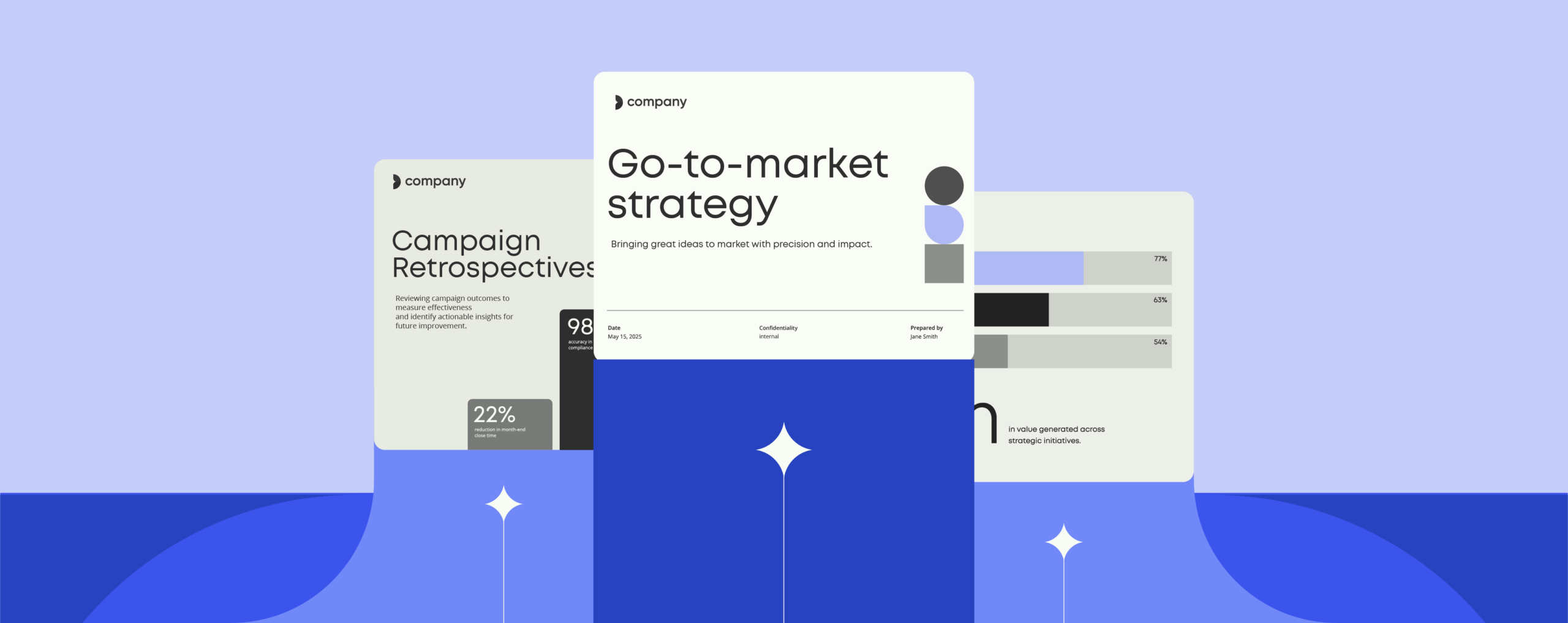
How to choose a document generation solution that delivers AI speed without sacrificing brand or compliance
If you create documents every day, you’re likely already using AI to brainstorm ideas and generate text faster.
So you’ll know that when it comes to business documents, tools like ChatGPT, Perplexity, and even Copilot can only get you so far. Without the right guidance, AI outputs end up off-brand, incorrect, and low-quality. And your teams end up rewriting and reformatting content at the eleventh hour.
Good news. There’s a better approach.
With document generation software, organizations can add controls to AI and automation, so every document follows company standards automatically.
Want to speed up document creation across your company—without losing control of your brand, quality, or compliance? We’ve broken down how document generation works, what to look for in a solution, and which tools actually deliver ROI in 2026.
document generation
5 document workflow challenges (at a glance)
Before we talk solutions, here’s what most teams are up against.
- Too much manual work
Teams waste hours fixing AI outputs, copying content from old documents, and hunting for the right templates or assets. - Inconsistent documents across teams
When everyone creates documents their own way, quality drops. Inconsistencies lead to errors, slower reviews, and a less professional impression. - Brand is hard to enforce at scale
Brand guidelines don’t help if people can’t find or apply them. Outdated logos, fonts, and messaging creep in, adding more review and rework. - Compliance relies on memory
In regulated environments, manual checks aren’t enough. Missing clauses or outdated language can quickly turn into real risk. - AI moves fast—but without control
AI speeds things up, but without guardrails it creates off-brand, low-quality content that needs fixing later.
What is document generation?
Document generation is software that automatically creates business documents like pitch decks, proposals, presentations, and reports.
It combines technologies like GenAI, AI agents, and rules-based automation to speed up document creation while giving organizations control over brand, tone of voice, compliance, and AI usage.
The result is far less manual work for employees and consistently high-quality documents, even as AI becomes part of everyday work.
How document generation works
Here’s what document generation platforms handle behind the scenes.
Start from a trusted foundation
Documents begin with dynamic templates that already include the right strcuture, branding, legal disclaimers, and approved content. Employees (and AI) never start from scratch or use outdated files.
Pull in the right content and data
The platform connects to systems like CRM, DAM, and other content sources to automatically populate documents with accurate, up-to-date data and assets.
Build and edit with company-approved AI and automation
Company-approved AI helps draft and refine content, while automation keeps information accurate and up to date. Teams can move faster without risking off-brand or non-compliant outputs.
Cut review and approval time
Because brand rules and required content are applied as documents are created, there’s far less to fix at the end. Reviews are faster, approvals are smoother, and documents are ready to send sooner.
Top 3 benefits of document generation
With the right platform, document generation creates measurable business gains that ripple out across the entire organization.
Here’s what that ROI looks like in practice, with real-world examples from organizations.
1. Save time and money across the business
Document generation automates the repetitive parts of document creation, from formatting and layout to filling in data and drafting content. Teams spend less time on admin work and more time on high-value, strategic tasks.
BDO Canada saved $1.65M in one year through improved efficiency
With Templafy, BDO Canada were able to get 4,500 employees, over 80+ locations, creating documents the same way. By simplifying their document creation process and cutting out inefficiencies, they saved more than $1.65 million in just one year.
2. Win more revenue with faster, better proposals
When sales teams can respond faster and with higher-quality documents, they stay in control of deals. Document generation removes document friction so teams can focus on selling, not scrambling to get proposals out the door.
IComm cut proposal creation time by 92% and increased win rates by 14%
Faster turnaround and more consistent proposals helped sales teams engage customers sooner and spend more time on deal strategy, supporting improved win rates.
3. Stay consistent and reduce global risk at scale
As your organization grows, keeping documents consistent and compliant is a big challenge. Document generation ensures every document starts from approved structures, content, and rules, which reduces errors and risk across regions.
ERM standardized documents for 8,000+ employees across 40+ countries
ERM used centrally managed document generation to support a global rebrand, enabling hundreds of thousands of documents to be created consistently and in line with brand and regional requirements worldwide.
Features checklist: document generation capabilities
Work smarter with automation
Discover new ways to save time and reduce errors with document automation. See how teams use smart tools to work faster.
When you’re evaluating platforms, use this checklist to make sure the solution is built for enterprise-scale document creation, not just small teams or simple use cases.
These capabilities determine whether document generation actually delivers speed, consistency, and control across the business.
Dynamic document templates
Centrally managed templates that can pull in data automatically, so updates roll out company-wide and maintenance costs stay low.
Centralized brand and content management
One place for approved logos, slides, text blocks, and disclaimers, so teams reuse the right content and avoid rework.
Rules-based document logic
Automatic control over sections, language, and formatting based on role, region, or document type, reducing errors and manual decisions.
Deep integrations with business systems
Direct connections to CRM, DAM, ERP, and other core systems, so documents and AI use accurate, trusted data by default.
AI-powered drafting and editing
Company-approved AI that helps teams draft and refine content faster, while staying aligned with tone, style, and compliance guidelines.
AI agents for document creation
AI agents that guide document creation end to end, reducing setup work and helping teams produce complete, compliant documents faster.
Context-aware personalization
Documents adapt automatically based on who’s creating them and how they’ll be used, without losing consistency or control.
Built-in brand and compliance enforcement
Brand and compliance rules applied during creation, not checked at the end, cutting review cycles and risk.
Review, approval, and version control
Collaboration, approvals, and version history built in, so teams can move fast without losing oversight.
Analytics and insights
Visibility into which templates, content, and documents are actually used, helping teams improve quality and efficiency over time.
Enterprise-grade security and governance
Strong access controls, audit trails, and governance over content, data, and AI usage.
How 5 enterprise platforms compare
To keep this practical, we’ve focused on five document generation platforms commonly evaluated by mid-to-large enterprises.
Feature comparison
| Capability | Templafy | Conga | Seismic | HotDocs | airSlate |
|---|---|---|---|---|---|
| Dynamic document templates | ✓ | ✓ | ◐ | ✓ | ◐ |
| Centralized brand and content | ✓ | ◐ | ✓ | ◐ | ◐ |
| Rules-based document logic | ✓ | ✓ | ◐ | ✓ | ✓ |
| Integrations with core systems | ✓ | ✓ | ✓ | ◐ | ✓ |
| AI-powered drafting and editing | ✓ | ◐ | ◐ | ✕ | ✕ |
| AI agents for document creation | ✓ | ✕ | ✕ | ✕ | ✕ |
| Context-aware personalization | ✓ | ◐ | ◐ | ✓ | ◐ |
| Built-in brand and compliance rules | ✓ | ◐ | ◐ | ✓ | ◐ |
| Review and approval workflows | ✓ | ◐ | ◐ | ◐ | ✓ |
| Analytics and usage insights | ✓ | ◐ | ✓ | ✕ | ◐ |
| Enterprise security and governance | ✓ | ✓ | ✓ | ✓ | ◐ |
Key:
✓ strong native capability
◐ partial or use-case dependent
✕ not a core focus
A closer look at the five platform
1. Templafy
Best for: Medium to large global enterprises that need to balance speed with brand consistency, compliance, and AI governance
Templafy is an enterprise document generation platform that works directly inside Microsoft 365, including Word, PowerPoint, and Outlook. It embeds brand rules, compliance requirements, company data, and company-approved AI into document creation, so teams can move fast without losing control. Document agents work behind the scenes to assemble documents end to end.
Limitations: Designed for organizations operating at scale, so it may be more than smaller teams need.
2. Conga
Best for: Enterprises heavily invested in Salesforce
Conga generates documents directly from Salesforce data and is commonly used for quotes, contracts, and reports tied closely to CRM workflows.
Limitations: Salesforce-centric, with less flexibility outside that ecosystem.
3. Seismic
Best for: Revenue teams focused on sales enablement and content performance
Seismic is a sales enablement platform that’s commonly used by sales teams to find the right materials, tailor them for prospects, and measure engagement.
Limitations: Document generation is not its primary focus. Seismic offers less control over brand governance, compliance automation, and end-to-end document assembly.
4. HotDocs
Best for: Legal, financial services, and regulated industries
HotDocs is a rules-based document automation tool designed for highly structured, compliance-heavy documents.
Limitations: More technical to implement, with limited modern AI-assisted drafting.
5. airSlate
Best for: Teams automating form-based workflows
airSlate combines forms, workflows, and document automation for operational processes like onboarding and approvals.
Limitations: Less focus on enterprise document standards, brand consistency, and AI-driven content quality.
ADDITIONAL CONTENT
Embed AI where it matters most—your documents
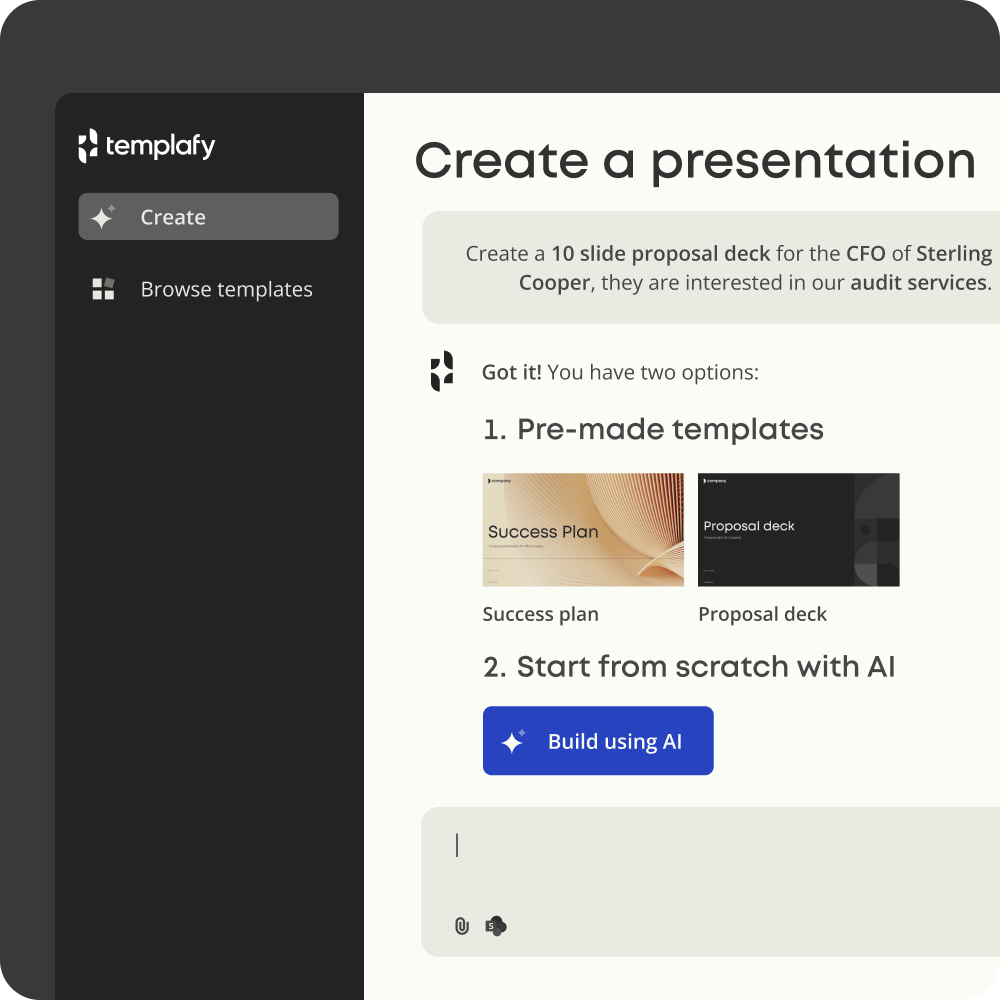
Discover how Templafy’s document agents work inside Word, PowerPoint, Excel, and Copilot to keep every document accurate, compliant, and on-brand.
Where most document generation tools fall short for enterprise-use
The problem is, most document generation tools are only built for one team or one workflow.
For example, Conga focuses on CRM-driven documents, while PandaDoc is optimized for sales proposals and signatures. They deliver value in specific scenarios, but their impact doesn’t extend beyond those workflows.
Adding separate tools for each team only creates more complexity and more inconsistency. It fragments how work gets done and makes control harder, not easier.
What enterprises need instead is a single approach to document generation that connects every team to company-approved AI, brand assets, and templates—inside the tools they already use.
Why enterprises choose Templafy for document generation
This is exactly the problem Templafy is built to solve.
Templafy automates the most important business documents across your entire organization. And it does so from inside the tools your teams already use, like Microsoft Word, PowerPoint, and Outlook—while connecting CRM, DAM, and other core systems.
The result? Employees spend less time creating documents and more time on strategic work. And organizations get consistency, security, and measurable ROI.
Here’s why leading enterprises choose Templafy.
AI-powered document agents create complete documents in seconds
Document agents create complete, business-ready documents in seconds, from start to finish.
With just a few lines of conversation with Templafy’s chatbot, document agents work behind the scenes to compile complete documents, using your company data and enterprise-safe AI, so every document is on-brand, compliant, and accurate.
Watch the video to see them in action.
Enterprise-grade security and governance
Templafy is designed with enterprise security, privacy, and compliance in mind, with controls that help organizations govern content, templates, and AI use at scale.
Discover Templafy’s security-first approach to document generation.
Deep integrations with the systems you already run on
Templafy plugs into the tools enterprises already depend on, including Microsoft 365 and other business systems, so documents can pull trusted data and approved assets without manual copy-paste.
Read more about Templafy’s integrations.
Why AI agents are the future of document creation
AI agents are completely revolutionizing the way we work. Instead of people managing tasks step by step, agents can take on end-to-end execution—handling coordination, applying rules, and producing outputs—while humans focus on direction, judgment, and review.
In fact, McKinsey has described AI agents as a key shift in how work is structured, moving organizations toward collaboration between people and intelligent systems that handle repeatable execution at scale.
Document work is one of the best places for agents to shine. It’s frequent, repeatable, rules-heavy, and high stakes. AI agents can assemble documents, apply brand and compliance standards, pull in the right data, and support review—consistently and at scale.
That’s why AI agents aren’t just an improvement to document creation. They’re the foundation for making it faster, safer, and far easier to manage across the enterprise.
Ready to see how document agents can create business-ready documents across your organization?
There’s a reason why 800+ leading enterprises, including firms like KPMG, BDO, and ERM, rely on Templafy to standardize document creation across their organizations.
Templafy gives enterprises control over how documents are created at scale. With approved templates, trusted data, governed AI, and document agents built in, teams can create high-quality documents faster and with far less effort.
Book a demo to see Templafy in action
In the demo, you’ll see how:
- Document agents help create real business documents from a simple request
- Brand, compliance, and approved content are applied automatically
- Templafy works inside Microsoft 365 and connects your existing systems
Book a demo or explore the Templafy platform to see Templafy in action.
Frequently asked questions about document generation
What is document generation?
Document generation is the automated creation of business documents using predefined templates, structured data, and rules. Instead of building documents manually, organizations generate consistent, accurate documents automatically across workflows like sales, HR, legal, and finance.
What is the meaning of document generation?
The term “document generation” refers to generating documents automatically rather than writing or assembling them by hand. It typically involves templates, data from business systems, and automation logic to ensure documents are accurate, consistent, and compliant.
What is document generation software?
Document generation software is a category of tools that automate how documents are created, formatted, and populated with content. These platforms often connect to systems like CRM, DAM, ERP, or HR tools and apply rules for branding, compliance, and structure during document creation.
What are document generation tools used for?
Document generation tools are commonly used to create proposals, presentations, contracts, reports, onboarding documents, engagement letters, HR packets, and other business-critical documents that need to be produced frequently and consistently.
What is automated document generation?
Automated document generation refers to using workflows, rules, and data connections to generate documents automatically with little or no manual input. This can include triggering document creation from a system event, automatically filling in data fields, or assembling entire documents based on predefined logic.
How does automated document generation work?
Automated document generation typically works by:
• Starting from a predefined template
• Pulling in data from connected systems like CRM or ERP
• Applying rules to control structure, content, and formatting
• Generating a complete document that’s ready for review or distribution
• Advanced platforms also include AI to help draft or refine content within defined rules
What’s the difference between manual, semi-automated, and fully automated document generation?
• Manual document creation relies entirely on people copying, pasting, and formatting content.
• Semi-automated document generation uses templates and data merges but still requires manual steps.
• Fully automated document generation assembles documents end to end using templates, data, rules, and automation, reducing manual effort and errors.
What are the key capabilities of document generation software?
Core document generation capabilities typically include:
• Template-based document creation
• Data merging and dynamic fields
• Rules-based content logic
• Integration with business systems
• Brand and compliance controls
• Review, approval, and version management
• Enterprise platforms add governance, security, and AI management on top
What are automatic document generation tools?
Automatic document generation tools are platforms that can create documents with minimal user input, often triggered by workflows or system events. They’re commonly used for high-volume or regulated documents where speed and consistency matter.
What is the best document generation software?
The best document generation software depends on your organization’s size and requirements. Enterprise teams typically look for tools that offer deep automation, strong integrations, brand and compliance governance, security, and the ability to scale across teams and regions, not just basic templates.
How do I choose the best document generation software for my organization?
When evaluating document generation software, consider:
• How deeply documents can be automated
• Whether templates and content are centrally governed
• How well the platform integrates with existing systems
• Support for compliance, security, and brand standards
• Scalability across departments and regions
These factors matter far more than surface-level features.
Is document generation only for large enterprises?
No. Document generation can benefit organizations of all sizes. However, enterprise-grade document generation platforms are designed to handle complexity, scale, compliance requirements, and governance that smaller tools often can’t support.
How does document generation help with compliance and brand consistency?
Document generation enforces approved templates, language, and rules during creation, not after the fact. This ensures documents stay compliant and on-brand automatically, reducing review cycles, rework, and risk.
How does AI fit into document generation?
AI can assist with drafting, editing, and personalizing content during document creation. In enterprise document generation, AI works best when it’s governed, meaning it uses approved content sources and follows brand, compliance, and tone rules.
What is the difference between document generation and eSignature tools?
Document generation focuses on creating and assembling documents. eSignature tools focus on signing and execution. Some platforms support both, but they solve different stages of the document lifecycle.

BLOG
Our Gartner report recap: How to think about AI in document management in 2026
February, 2026
4 min read
As generative and agentic AI move from pilots into daily use, organizations are being forced to confront a practical reality: AI only delivers value when it is grounded in structured, accessible, and well-governed content.
Read more

BLOG
Templafy Talks: What we learned about AI maturity
February, 2026
9 min read
In this Templafy Talks, we explored what AI maturity really looks like in large organizations. We discussed why documents are such a useful way to assess AI maturity, and how factors like governance, data readiness, and user experience shape whether AI delivers real value or creates new problems.
Read more

BLOG
The DAM buyer's guide for 2026
December, 2025
18 min read
This comparison breaks down what DAM software does, how to compare the top platforms, and where tools like Templafy fit into the bigger picture of brand governance and content automation. It’s everything buyers need to understand the DAM landscape in 2026.
Read more