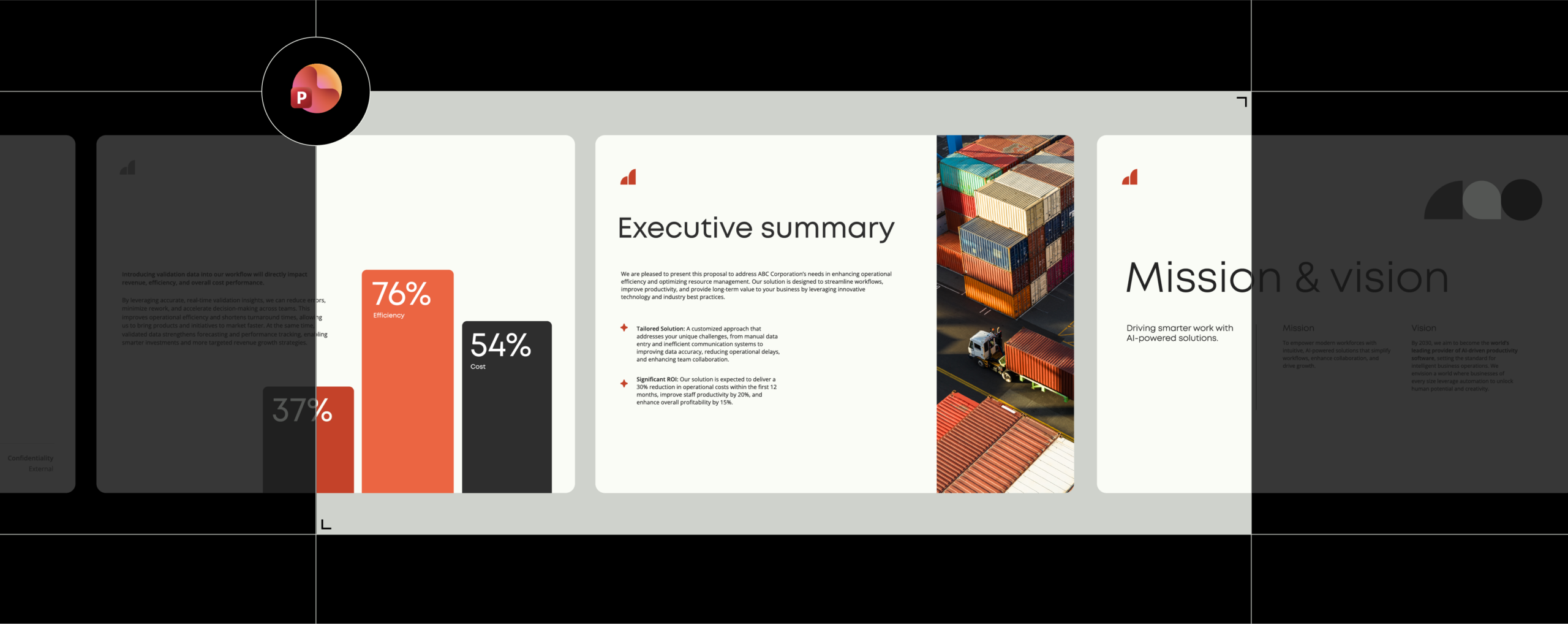

Templafy Agent add-in for PowerPoint
One agent to create, edit, review, and search for content, right inside PowerPoint.
PowerPoint isn’t dead. It’s just finally getting good.

How to create enterprise-quality AI presentations without leaving PowerPoint behind
Every few years, a new wave of technology promises to kill PowerPoint. This time, it’s AI presentation makers that can draft a polished-looking deck in minutes.
On the surface, they’re impressive. But these tools were never meant for business-use. They might demo well, but put them in a business context where accuracy, consistency, and quality matter and things quickly fall apart.
The problem isn’t PowerPoint, it’s the way we’re using it. In fact, paired with the right AI tools and governance, PowerPoint becomes the foundational infrastructure that enables organizations to cut out manual document work and scale the benefits of AI across the organization.
We grabbed a coffee with Templafy’s Chief Product Officer, Oskar Konstantyner, to find out how.
Most AI presentation tools aren’t built for business
Why are AI presentation tools suddenly everywhere?
Because creating presentations is genuinely hard and time-consuming. Knowledge workers spend almost half their working day on documents and presentations. A huge amount of that time is spent on repetitive tasks, like finding the right data, locating approved assets, formatting slides, and rebuilding narratives that already exist somewhere else in the business. AI is a natural fit for that kind of work, so the appeal is obvious.
What’s the problem with AI-first presentation tools?
Tools like Gamma, Tome, and Beautiful.ai are great at what they’re designed to do. They help individuals brainstorm and get to a polished first draft quickly.
But professional presentations need to be accurate, up to date, on‑brand, and high quality. Content should come from trusted, company‑approved sources; otherwise, any time savings are quickly lost in rework. Inaccurate or non‑compliant content also becomes a serious business risk.
Then there’s the workflow issue. A presentation is rarely a finished output. It gets reviewed, updated, reused, and shared across teams, departments, and organizations. It needs to work in formats people already know, inside systems they already use, and across the wider content ecosystem. That’s the reality of enterprise presentations, and most AI presentation tools simply weren’t built for it.
Enterprise presentation workflows need to be PowerPoint compatible
Could these tools realistically start to replace PowerPoint?
For some use cases, maybe. For enterprise work, it’s hard to see. PowerPoint’s been part of how businesses communicate for nearly four decades. It’s on virtually every desktop, understood by almost everyone, and it doesn’t require a shared platform or any special access to collaborate across companies. That kind of ubiquity’s genuinely hard to replace.
The bigger opportunity is to keep that format and make it dramatically better instead of walking away from it.
Is PowerPoint’s reputation for being slow and painful fair?
To a point, yes. Creating high‑quality presentations has always been slow, manual, and repetitive. That friction’s exactly what drove people towards new AI tools in the first place.
The difference now is that AI can remove most of that effort without abandoning the format that already works at enterprise scale. The right tools can generate first drafts, surface relevant content, and pull approved information into presentations automatically, so teams can focus on the thinking rather than the assembly.
What about Copilot?
Copilot is genuinely useful, but it’s a general-purpose tool. It can access company information, but that doesn’t automatically mean the output is presentation-ready, on-brand, or compliant. What enterprises need is AI that works from approved sources and follows company rules from the start, so what comes out is ready to use rather than something that needs another round of fixing before it goes anywhere.
FREE POWERPOINT AGENT
Create a PowerPoint presentation instantly with AI.
What good looks like: AI agents and governance inside PowerPoint
What should enterprises look for when evaluating AI presentation tools?
They should be looking for AI agents that handle the whole job, not just text or slides. That means finding the right template, pulling in the right content, and applying company standards so the output’s actually ready to use. Agents like that only work well when they’re governed. Without the right guardrails, you don’t solve the consistency problem, you simply scale it.
So how does Templafy solve that?
Templafy’s Document Agents work natively inside Microsoft 365 and PowerPoint. They turn a prompt into a business‑ready presentation using centrally managed templates, approved slides, trusted content, and live company data. The agent starts from sources the business already trusts, applies approved branding, and follows company standards from the start. Teams spend less time assembling presentations and less time fixing them afterwards.
What about industries where the stakes around accuracy are especially high-stakes?
That’s exactly the kind of work Templafy is designed to handle. In industries like accounting, financial services, and professional services, a wrong number, outdated slide, or missing disclaimer creates real business risk. Templafy reduces that risk by connecting documents to verified data, approved content, and compliance requirements from the start, so accuracy becomes part of the workflow rather than an afterthought.
Document generation is one of the highest-ROI use cases for enterprise AI
For anyone who hasn’t come across Templafy before, how would you describe it?
Templafy’s an AI agent‑based document generation platform that lets people across any team, whether that’s sales, finance, legal, or anything else, create business‑ready presentations, proposals, reports, and contracts from inside the tools they already use, like Word, PowerPoint, Excel, Copilot.
Thanks to Templafy MCP, it now works inside any AI platform too. You describe what you need and the agent handles the rest.
How does Templafy connect to the systems businesses already have?
It connects to your entire document ecosystem. That includes your CRM, your digital asset management platform, and your approved content libraries. Every document starts with the right branding, current legal disclaimers, and up‑to‑date product information.
Why is document generation such a strong case for enterprise AI?
Because documents are universal. Every team creates them. When you apply AI agents to document workflows, you’re not solving a niche problem for one department, you’re improving how the whole organization operates. The impact’s easy to see. Instead of abstract productivity gains, you get finished, compliant documents created in less time and with fewer errors. That’s a return on investment that finance and leadership can recognize immediately.
How leading organizations get measurable ROI with Templafy
There’s a reason more than 800 leading global enterprises trust Templafy to generate documents at scale.
“Last year, we generated over 120,000 documents through Templafy, saving us about $1.65 million.”

Brion Hendry
Partner, BDO
“With Templafy, we’ve found the key to the productivity promise of AI without the risk. It’s simple to manage, easy to use, and helps everyone deliver reliable business content much faster.”

Kaisa Nummela
Portfolio Owner, Tietoevry
Ready to go from prompt to PowerPoint?
We got tired of seeing AI generators that don’t meet professional standards, so we built a free version of our Agent-powered presentation generator.
It turns a single prompt into a complete, professional presentation, that’s either ready-to-send, or ready to edit directly in PowerPoint.
Want to see what the full Templafy platform could do for your teams? Speak with one of our document experts and get a personalized walkthrough built around your organization’s needs.

BLOG
Gartner® just named Templafy a Cool Vendor in 2026 Coolest Vendor Innovations in Digital Workplace Applications
October, 2026
7 min read
AI is everywhere in the enterprise. So why are leaders still finding it difficult to turn adoption into meaningful productivity gains? This is exactly the challenge Gartner examines in its recent report, Coolest Vendor Innovations in Digital Workplace Applications.
Read more
BLOG
Beyond the First Draft: Closing the AI Productivity Gap
October, 2026
6 min read
‘The Business-Ready AI Gap 2026’, Templafy’s new report based on a survey of 2,000 knowledge workers who use AI to create business documents at least once a month in the UK and US, alongside Templafy platform data, reveals the gap between a first AI-generated draft and something that’s ready to share.
Read more
BLOG
Brand governance vs. brand compliance: The crucial difference in the AI era
September, 2026
14 min read
7 ways to keep AI-generated documents accurate, current, and on-brand at scale.
Read more