Templafy Talks: Going beyond text to generate full documents

AI agents are everywhere. But most enterprises are still figuring out how to turn AI output into something they can actually use.
AI agents are now part of daily work in many enterprises. Teams are building workflows in Copilot, Gemini, Glean, and other platforms to move faster and automate more.
But generating text is not the same as generating a usable business document.
In this session of Templafy Talks, John Tiniakos was joined by Stephan Laarhuis and Arjen Hartog to explore what it really takes to generate complete, business-ready documents with AI.
About Templafy Talks
Templafy Talks is our ongoing webinar series focused on document automation, AI, and how enterprise teams actually work. Each session brings together practical examples, live demos, and lessons from real implementations.
This session focused on a growing challenge: how to add structure, governance, and brand control to AI-generated content.
With Templafy’s Document Generation API, AI agents can generate full documents such as pitch decks, proposals, onboarding materials, and internal reports. The key difference is that these documents are built on approved templates and business rules, not free-form text.
Speakers
- John Tiniakos, Senior Principal Customer Success Manager, Templafy
- Arjen Hartog, Director of Product Management & Managing Director, Templafy
- Stephan Laarhuis, Field CTO, Templafy
The ambition, the challenge, and the enterprise gap
From prompt to presentation
Book a demo to see how Templafy simplifies document creation, keeps your brand on track, and boosts efficiency.
“Enterprises are rapidly adopting AI platforms to build and automate workflows. The ambition is clear. We want faster document creation, smarter workflows, and obviously scalable productivity.”

John Tiniakos
Senior Principal Customer Success Manager, Templafy
As AI tools evolve for enterprise needs, workflows are speeding up and becoming more and more automated. Proposals, sales decks, contracts, and onboarding materials (just to name a few) are now being generated through AI-supported flows in a fraction of the time.
However, speed alone does not guarantee document satisfaction. When AI generates content without structure, the results can be unreliable.
“AI outputs are often inconsistent and can be non-compliant. Agents lack understanding and context. There’s no way for them to understand the template that should be used or understand layouts.”
John Tiniakos
Senior Principal Customer Success Manager, Templafy
AI does not inherently understand which template should be applied, which legal disclaimer is required in a specific region, or how brand guidelines translate into slide layouts. It may produce good text, but that does not mean the output is ready to send to a client or leadership team.
This is what we refer to as the enterprise AI gap. It is the gap between conversational AI output and documents that meet enterprise standards for brand, compliance, and quality.
How is AI being used today?
We asked webinar attendees a few questions about how their organizations are actually using AI right now.
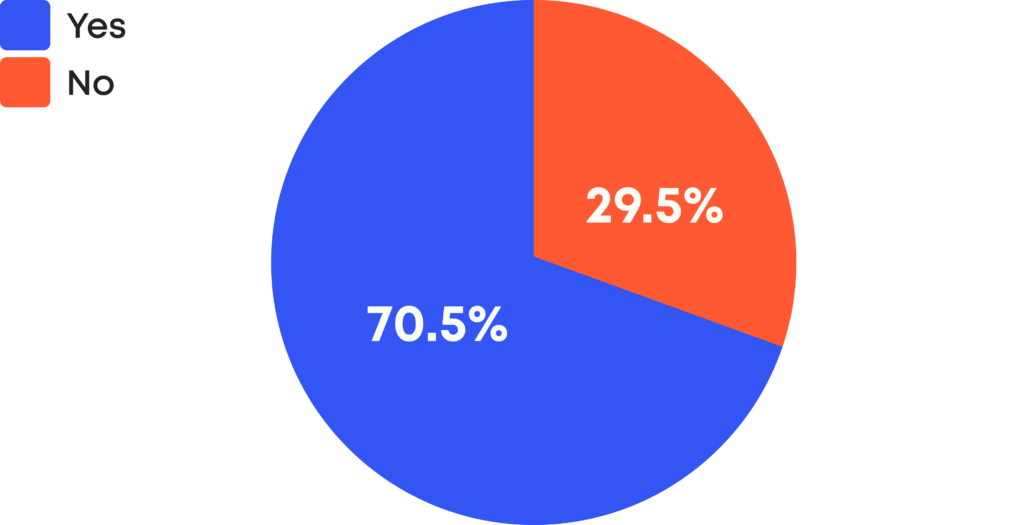
Have you started building AI agents in your organization?
First, the big picture: 70.5% of attendees said their organization has already started building AI agents. So if you feel like everyone around you is moving fast on this, you’re not imagining it.
Percentage of functions building AI agents
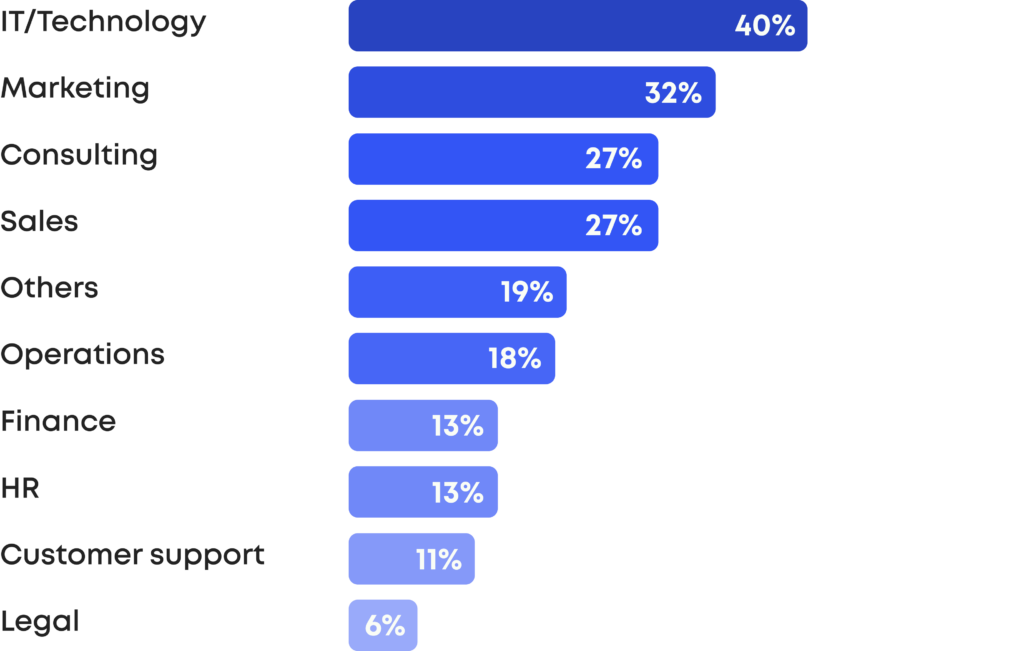
When it comes to who inside a company is doing the building, IT and Technology teams are leading the charge at 40%. But it’s not just a tech department project. Marketing (32%), Sales and Consulting (both 27%), and Operations (18%) are all actively building agents too. AI workflows are spreading across the business, not just sitting in one corner of it.
Percentage of customers using the platform to build AI agents
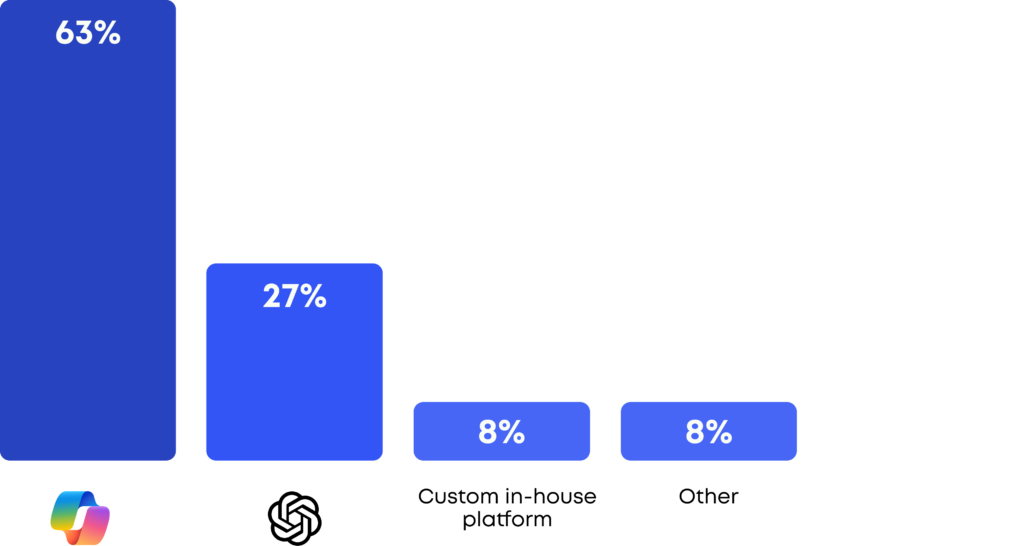
As for which platforms people are using, Microsoft Copilot Studio came out on top by a wide margin, with 63% of respondents building on it. OpenAI GPT came in second at 27%, while custom in-house platforms and other tools each accounted for 8%.
How Templafy pushes AI solutions further
Modern enterprise AI tools are very good at gathering information. They can analyze an RFP, search across systems like Salesforce, Slack, or Gong, and summarize large amounts of data in seconds. For many teams, this already feels like a major productivity boost.
But in many cases, the output stops at chat.
Forward-looking enterprises are already connecting AI to multiple data sources and using it to create richer context.
“What we see is that enterprises who are a little bit ahead of the rest are bringing data together and pulling from all kinds of sources…It is then our task to take in that context and turn it into a business document.”

Stephan Laarhuis
Field CTO, Templafy
AI can gather context and can even interpret intent. It’s very good at structuring raw information. What it can’t reliably do on its own is turn that context into a fully branded, compliant document that follows company standards.
That’s where a governed document generation layer becomes essential. Many assume that if AI can generate text, it can generate finished documents. In practice, this is rarely the case.
“AI alone is not able to create a high-fidelity PowerPoint deck or Word document. AI may create good stuff, but it’s not creating something in line with your brand.”

Arjen Hartog
Director of Product Management & Managing Director, Templafy
This distinction matters most in customer-facing documents. A proposal or onboarding deck is not just a container for information. It reflects the company’s brand and credibility. Without structure, AI-generated documents often require heavy review and manual correction.
Templafy connects AI agents to a framework that ensures the final output is fully aligned with enterprise standards.
The Templafy use case library
Are you thinking big enough about what AI-powered document generation can do for your business?
In this guide, we share customer-proven examples of how teams across your organization can use Templafy to create better documents faster, with less risk.
From simple prompts to structured outputs
Keep up with AI
Get practical tips and real stories on how AI is changing document work. Stay informed and make smarter choices for your team.
The magic of agentic workflows is in their simplicity. During the live demo, we showed how you can create documents by typing short, natural instructions such as “Can I have an onboarding deck?” or “Create an NDA”.
Users don’t need special training, and they don’t have to dig through folders to find the right document templates. All of the context is built in so the AI agent can quickly complete the task.
“What I really like about this, as you’re typing, is the simplicity of the prompt. I think one of the things that Copilot has struggled with, as a lot of AI tools have, the output is always dependent on how good the prompt is. In the examples you’re showing, the prompts are extremely simple.”
John Tiniakos
Senior Principal Customer Success Manager, Templafy
Instead of relying on perfectly crafted prompts, the AI agent collects the necessary structured inputs in the background. It pulls relevant data from connected systems and confirms key details before sending a structured payload for document generation API.
“Copilot Studio is basically the workflow builder environment to make agents in your Microsoft ecosystem.”
Arjen Hartog
Director of Product Management & Managing Director, Templafy
Within tools like Copilot Studio, teams can define: how an agent gathers data, which systems it connects to, and what information must be included before a document is created. Once those inputs are structured, Templafy applies approved templates, business rules, and brand logic to generate the final document in Word, PowerPoint, or PDF.
From the user’s perspective, it feels effortless. By simply typing a short request, they receive a complete document that matches their company’s brand standards. Behind the scenes, the process is governed, structured, and repeatable. That combination is what turns AI from a drafting assistant into a reliable document engine.
“The reason why I like the technology that we’re offering here today so much is that it helps to make an AI driven process quite efficient because it lands into a standardized output. It avoids the hefty reviews that you need to go through if something is randomly generated with AI.”
Stephan Laarhuis
Field CTO, Templafy
AI is the feature, accuracy is the goal
When AI generates content without guardrails, teams simply shift the time they save at the start of the process with in-depth content reviews. Legal must double-check disclaimers, marketing must fix layout and branding, and sales must adjust the specific wording and offers.
When AI operates inside a structured framework, the dynamic parts can still benefit from automation while the foundation remains trusted and consistent. Because without reliable, accurate outputs, AI isn’t even a feature, it’s a liability.
BLOG
The best AI presentation generators in 2026 (tested for business-use)
March, 2026
23 min read
Ever found yourself editing slides moments before a big pitch? Then you already know why AI presentation tools are one of the fastest growing categories in workplace tech. In this guide, we compare the most popular AI presentation generators for enterprise readiness, so you can find tools that truly work for business.
Read more

BLOG
Our Gartner report recap: How to think about AI in document management in 2026
February, 2026
4 min read
As generative and agentic AI move from pilots into daily use, organizations are being forced to confront a practical reality: AI only delivers value when it is grounded in structured, accessible, and well-governed content.
Read more

BLOG
Templafy Talks: What we learned about AI maturity
February, 2026
9 min read
In this Templafy Talks, we explored what AI maturity really looks like in large organizations. We discussed why documents are such a useful way to assess AI maturity, and how factors like governance, data readiness, and user experience shape whether AI delivers real value or creates new problems.
Read more