Templafy Talks: What we learned about AI maturity


Lessons from enterprise document workflows on what makes AI work at scale
About Templafy Talks
Templafy Talks is our ongoing webinar series focused on document automation, AI, and how people actually work in modern organizations. Each session brings together live conversations, real use cases, and practical lessons from enterprise teams.
In this session, we explored what AI maturity really looks like in large organizations. We discussed why documents are such a useful way to assess AI maturity, and how factors like governance, data readiness, and user experience shape whether AI delivers real value or creates new problems.
Speakers
- John Tiniakos, Senior Principal Customer Success Manager, Templafy
- Christian Lund, Co-founder, Templafy
- Oliver Gudmandsen, Senior Enterprise Account Manager, Templafy
“A lot of businesses are currently trying to figure out what AI actually means for them and where they can use it. To do that, you need to look at maturity states. Inputs, data, structure, governance. All of that matters.”

Christian Lund
Co-founder, Templafy
As AI tools become more powerful and easier to access, the real value of AI depends less on having the tools and more on how well they are used.
AI maturity is about how reliably an organization can use AI in everyday work, at scale. When AI is used without proper planning or guardrails, results can be inconsistent and compliance risks can increase.
Our discussion showed that AI maturity develops over time. Organizations move through clear stages, starting with experimentation and later moving toward more structured use. Early on, teams test possible use cases, and over time the focus shifts to data quality, governance, and fitting AI into existing workflows.
This is why AI maturity is now a business issue, not just a technical one. Without a shared understanding of what good AI use looks like, organizations may invest heavily in AI without seeing lasting results.
Where AI maturity becomes visible: everyday documents
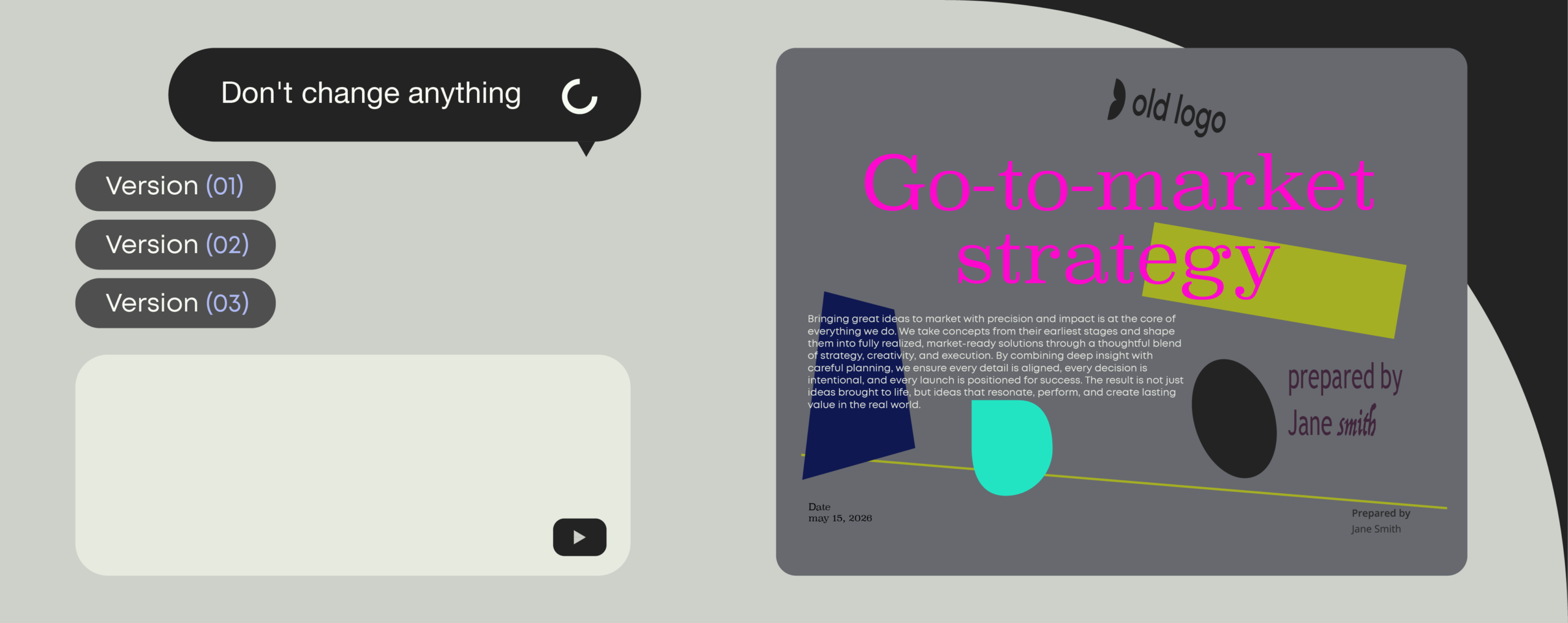
From prompt to presentation
Book a demo to see how Templafy simplifies document creation, keeps your brand on track, and boosts efficiency.
“There’s a massive gap between how users see themselves and their maturity. Some folks are really far along…but they’ll say we don’t really have a structure yet, we’re not that mature. While other customers have maybe done a pilot of some sort and thought they were very advanced.”

Oliver Gudmandsen
Senior Enterprise Account Manager, Templafy
Many organizations believe they are further along with AI than they actually are. Teams may be experimenting with tools or running pilots, but those efforts often sit at the edges of the business rather than inside core workflows.
That gap shows up quickly when AI is not designed to scale. Individual teams might see short-term gains, but without shared standards, results are inconsistent. Some employees rely heavily on AI, others avoid it, and output quality varies widely, leading to overall friction.
“In companies with 100,000 employees, everyone is [creating documents.] That makes it a very good place to assess AI maturity.”
Christian Lund
Co-founder, Templafy
This is why documents and presentations are often a good place to start, both with assessing AI maturity and improving it. Unlike dashboards or niche tools, documents are created by almost everyone, every day. They’re high-volume and high visibility, making them an honest reflection of how mature your AI usage really is.
When AI maturity is low, it shows up in documents through uneven messaging, outdated content, and extra manual work. As maturity improves, documents become easier to create and safer to share.
“If you don’t have good data structures to source from, you won’t get good results. That’s not new. Garbage in, garbage out still applies.”
Christian Lund
Co-founder, Templafy
Data readiness is the quiet blocker of AI success
AI maturity often stalls for reasons that have little to do with the AI itself. In many cases, the real constraint is your data.
For AI to produce reliable results, the information behind it needs structure, context, and clear ownership. When data is outdated, scattered, or poorly managed, AI reflects those problems in its outputs. This shows up clearly in document workflows, where small errors or inconsistencies can quickly spread across teams.
A key theme in the session was the need to reset expectations. Most organizations are not fully ready for AI, and that’s normal. Improving data readiness is often less about adding new technology and more about doing the basics well. Clearly defining approved content, trusted data sources, and how information should be used gives AI the foundation it needs to work effectively.
The AI maturity assessment guide
How well is your organization using AI?
As with all technologies, AI use is not binary. There is no singular way to use AI tools for maximum impact.
Our assessment guide helps you see how mature your AI usage is today.
AI should adapt to users, not the other way around
“Users shouldn’t need to become prompt engineers…The companies moving fastest are the ones putting AI tools in people’s hands that don’t require new behavior. People use them almost without noticing.”
Christian Lund
Co-founder, Templafy
One of the clearest signs of AI maturity in an organization is how easy it is for employees to use it correctly. When AI tools require people to learn new interfaces, figure out complex prompts, or change how they work, adoption drops quickly.
Mature AI fits naturally into existing workflows and is guided by clear intent. Instead of asking users to explain how AI should work, the system already understands the rules, context, and goals of the task.
Governance makes AI usable at scale
“For a long time, AI was exciting because of speed. Something that took three hours suddenly takes twenty seconds. But speed alone isn’t enough. You also need quality, accuracy, and consistency.”
Christian Lund
Co-founder, Templafy
Speed and automation are valuable, but without clear limits, they can introduce risk just as quickly. When AI creates content at scale, even small mistakes can spread quickly. Mature AI adoption takes this risk seriously and builds governance directly into the workflow, rather than adding it as a separate review step.
The discussion made it clear that governance is not about slowing teams down. It’s about building trust. When rules for brand, legal, and approved content are built into AI systems, people can work faster without questioning the results.
Understanding the five AI maturity stages
Keep up with AI
Get practical tips and real stories on how AI is changing document work. Stay informed and make smarter choices for your team.
If you’re following along with the full webinar, you have the chance to complete the AI maturity assessment and get your score. Based on your answers, your organization will fit into one the five different stages:
1. Open observer
AI is explored informally. Individuals test tools on their own, with no shared standards. In documents, this leads to inconsistent quality and limited impact.
2. Cautious experimenter
Teams run pilots and proofs of concept, often in isolation. AI helps in specific cases, but results are hard to scale across document workflows.
3. Strategic builder
AI use is guided by business goals and data governance. Document creation becomes more standardized, with clearer rules for accuracy, brand, and compliance.
4. Change maker
AI is embedded in core processes. Documents are created faster and more consistently, with governance built directly into workflows.
5. AI innovator
AI is treated as a strategic capability. Purpose-built agents generate complex, compliant documents automatically, based on business rules rather than individual prompts.
What AI maturity looks like in practice
“What we mean by AI maturity is where our customers, or the market in general, are on that journey. A while back, everyone agreed that AI is something you have to have. For enterprises, it’s a prerequisite now. But what that actually means looks very different from company to company.”
Christian Lund
Co-founder, Templafy
AI maturity often stalls for reasons that have little to do with the AI itself. In many cases, the real constraint is your data.
For AI to produce reliable results, the information behind it needs structure, context, and clear ownership. When data is outdated, scattered, or poorly managed, AI reflects those problems in its outputs. This shows up clearly in document workflows, where small errors or inconsistencies can quickly spread across teams.
A key theme in the session was the need to reset expectations. Most organizations are not fully ready for AI, and that’s normal. Improving data readiness is often less about adding new technology and more about doing the basics well. Clearly defining approved content, trusted data sources, and how information should be used gives AI the foundation it needs to work effectively.
Watch the full Templafy Talks session
This article highlights just a few of the insights shared during this Templafy Talks session. To explore the full discussion and see real examples, watch the complete session on demand.
BLOG
The best AI presentation generators in 2026 (tested for business-use)
March, 2026
23 min read
Ever found yourself editing slides moments before a big pitch? Then you already know why AI presentation tools are one of the fastest growing categories in workplace tech. In this guide, we compare the most popular AI presentation generators for enterprise readiness, so you can find tools that truly work for business.
Read more

BLOG
Our Gartner report recap: How to think about AI in document management in 2026
February, 2026
4 min read
As generative and agentic AI move from pilots into daily use, organizations are being forced to confront a practical reality: AI only delivers value when it is grounded in structured, accessible, and well-governed content.
Read more
BLOG
Templafy Talks: Going beyond text to generate full documents
February, 2026
9 min read
This Templafy Talks session focused on a growing challenge: how to add structure, governance, and brand control to AI-generated content.
Read more