Why do businesses need to orchestrate documents centrally?

When AI creates business documents, organizations must control the brand, consistency, and quality.
The first wave of enterprise AI was about access: putting powerful AI tools in the hands of everyone who creates documents. But access was the easy part. Employees were already finding and using AI tools, whether they had been approved or not.
Now comes the harder challenge: making AI-generated documents trustworthy at enterprise scale. AI can research, write, and synthesize at speed. But it doesn’t automatically know your latest pricing, approved messaging, brand guidelines, legal clauses, templates, business rules, or security requirements. Every time you generate a document with AI, it starts from scratch and doesn’t use pre-approved sections, which reduces the consistency of the documents.
Turning generated content into business-ready documents means connecting AI to that organizational context, and to the controls that govern how it is applied at scale. It means AI is not reinventing the wheel and is only creating parts that need to be created with AI.
And that’s the role of document orchestration.
What is document orchestration?
Document orchestration is the operating model for coordinating the systems, data, approved content, templates, and business rules that shape business documents, whether they are created by an employee, automated workflow, or AI.
It removes the need for every employee or AI agent to independently find the latest source material, prompt correctly, select the right template, apply the appropriate clauses, and assemble a compliant document.
Instead, AI and document workflows connect to centrally managed knowledge, data, content, and controls. The right inputs can then be applied according to the document’s purpose, audience, geography, business unit, permissions, and risk profile.
For enterprise leaders, this creates a scalable layer of control. Standards can be managed centrally and applied consistently, even as document creation becomes distributed across more people, multiple AI tools and applications, and AI agents.
Before AI, there was document orchestration
Document governance didn’t begin with GenAI. Enterprises have always needed to manage the content, data, templates, rules, and approvals behind the documents their people create.
For more than a decade, document orchestration platforms such as Templafy have helped enterprises bring those elements together across the document technology stack.
But AI raises the stakes. It dramatically increases the speed, scale, and number of ways business documents can be created. The more ways people and AI agents can generate documents, the more important it becomes to ensure they use the right information, follow the right rules, and produce outputs the business can stand behind.
The hidden costs of ungoverned AI
Without these controls, AI is scaling document generation faster than many enterprises can govern it.
Teams are working across multiple LLMs, enterprise copilots, AI assistants, and increasingly AI agents, with much of the responsibility still falling on individuals to provide the right context, prompt correctly, and review the final output for any inconsistency.
Ask three employees to create the same proposal and you could get three very different documents, built using different tools, prompts, source files, and information. None is guaranteed to use the approved messaging, current template, or required legal compliance.
That starts to erode the productivity gains AI promises. Time saved generating content is spent searching for the right inputs, checking outputs, correcting inconsistencies, and getting documents ready for business use. And the consequences go far beyond productivity:
- Inconsistency: Quality, structure, tone, and brand execution vary across users, tools, prompts, and source material.
- Compliance risk: Required clauses, disclosures, templates, and approval steps rely on prompts and manual checks rather than being built into the workflow.
- Inaccurate information: Outdated or unverified content and data can make its way into high-stakes documents.
- Duplicated effort: Teams repeatedly search for content, retrieve data, fix formatting, and recreate work that already exists.
- Security exposure: Moving company information across disconnected AI tools makes access and data use harder for IT to govern.
AI may get teams to a first draft quickly, but without the right orchestration infrastructure, that draft won’t be fit for enterprise use.
The components of document orchestration
So, let’s look more closely at what we actually need to orchestrate.
Document orchestration connects the components that shape a business document—from the AI creating it to the enterprise knowledge, data, content, templates, and rules behind it.
That includes:
- AI tools and agents that research, draft, refine, and assemble proposals, presentations, contracts, reports, and client communications.
- Trusted enterprise knowledge such as current product information, policies, approved messaging, and best-practice documents.
- Structured business data from systems such as CRM and ERP, including customer details, pricing, financial figures, and contract dates.
- Approved content and templates that provide controlled foundations for brand, messaging, structure, and formatting.
- Business rules and workflows that determine which clauses, disclaimers, data, branding, permissions, and approvals apply.
- Rules-based automation that handles predictable work such as document assembly, formatting, data insertion, conditional content, and approvals.
The important point is that not everything needs AI. A legal clause doesn’t need to be generated if the correct version can be applied automatically. Customer data already held in CRM doesn’t need to be inferred. A mandatory approval should not depend on a model remembering to request it.
AI adds value where language, reasoning, and adaptation matter, while parts like data, rules, approved content, and automation provide certainty where consistency matters. Document orchestration brings them together.
The benefits of document orchestration
With these components connected, enterprises can move beyond isolated AI productivity gains and improve the document workflow as a whole. Instead of relying on individuals to give AI the right context and correct its outputs, the right information and controls are already built into the process.
That helps enterprises:
- Improve document quality by grounding outputs in trusted knowledge, structured data, approved content, and centrally managed standards.
- Accelerate document workflows by reducing time spent searching, copying, formatting, checking, and correcting.
- Build governance into creation so brand, content, data, compliance, permissions, and approvals are applied as part of the workflow.
- Use AI more efficiently by applying it where language, reasoning, and adaptation add value, while rules and automation handle predictable work.
- Apply consistent standards at scale across teams, regions, document types, AI tools, and business applications, regardless of which team is creating the documents or which application they started from.
How Templafy solves the document orchestration problem
As we mentioned, Templafy didn’t start with AI. For more than a decade, we’ve helped enterprises manage the templates, content, data, brand, and business rules behind their most important documents. That foundation has evolved into an agentic document generation platform built to orchestrate increasingly AI-powered document workflows.
At its core, Templafy is built for document orchestration. It brings AI together with company-approved knowledge, enterprise data, content, templates, business rules, and automation so organizations can create high-quality, consistent, business-ready documents at scale, without giving up control over how they are created.
How Templafy works
Templafy connects the components behind document creation through a centralized document orchestration layer, then makes those capabilities available wherever employees choose to work.
That might be directly inside Microsoft 365, where teams are already creating presentations and documents. Or it might be inside their preferred AI tools, including ChatGPT, Claude, and Copilot. Different teams can use different tools—or a combination of them across the organization—while Templafy provides a consistent layer of enterprise knowledge, data, content, rules, and governance behind document creation.
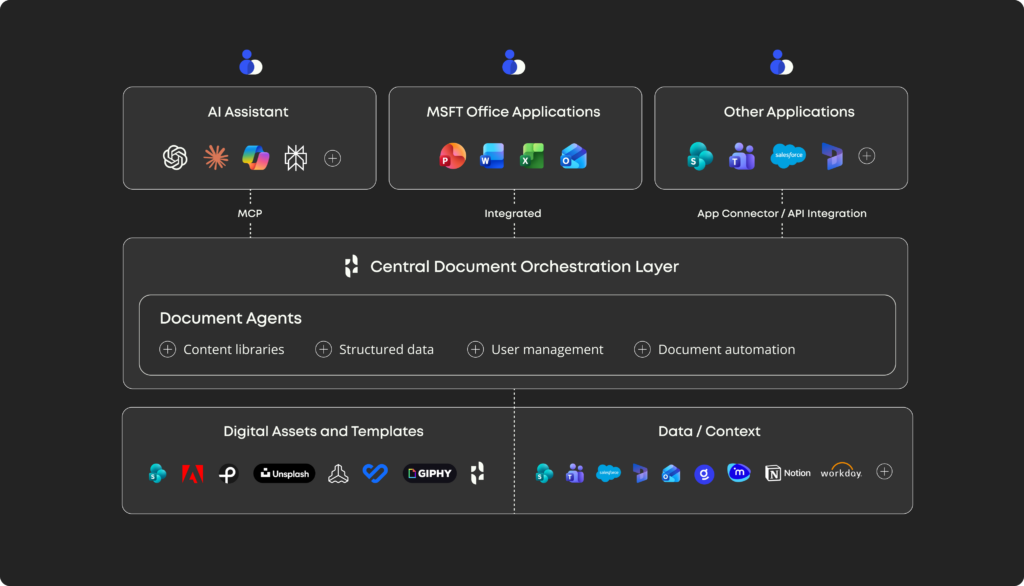
Here’s how it works:
Document Agents
Templafy Document Agents generate and compile business documents using the relevant data, content, rules, and instructions for each workflow. AI handles the work that benefits from reasoning and language generation, while governed enterprise inputs shape the final document.
Enterprise knowledge and data
Document Agents can work with approved company knowledge and structured data from enterprise systems such as CRM and ERP platforms. This grounds document creation in trusted business information without relying on employees to manually find, copy, and prompt with the right inputs.
Templates, content, and business rules
Centrally managed templates, approved content, brand assets, clauses, and business rules are applied during document creation, helping ensure the resulting document meets enterprise requirements from the outset.
Rules-based automation
Templafy uses rules-based automation alongside generative AI for predictable work such as document assembly, formatting, data insertion, conditional content, and approvals. This keeps AI focused on the tasks where reasoning and language generation add value.
Orchestration across your AI ecosystem
Through Templafy MCP, organizations can bring Document Agents and governed document capabilities into external AI environments. So, whether employees are working in Microsoft 365, ChatGPT, Claude, Copilot, or across multiple AI tools, the document orchestration layer can remain consistent.
Watch Document Agents orchestrate a business-ready document
Here’s what that looks like in action. Watch a Document Agent bring together AI, enterprise knowledge, data, approved content, templates, and business rules to create a business-ready document.
Ready to see what document orchestration looks like for your organization?
More than four million people across leading enterprises like KPMG and BDO use Templafy. The best way to understand the difference is to see it for yourself.
You can experience some of Templafy’s capabilities today by downloading the Templafy add-in through Microsoft Marketplace or trying our free web-based PowerPoint generator.
For enterprise teams looking to orchestrate document creation across people, systems, and AI tools, the best way to experience the full Templafy platform is to speak with one of our document experts.
They can answer your questions, explore the document workflows and use cases that matter to your organization, and show you Document Agents working in practice.
Try Templafy from:





BLOG
The AI productivity paradox: Why AI drafts still take hours to finish
October, 2026
12 min read
AI is everywhere in the workplace. But despite widespread adoption, enterprises are still struggling to turn AI-generated content into real business value. So what's holding businesses back?
Read more

BLOG
Templafy Talks: 3 takeaways for orchestrating AI document creation
October, 2026
8 min read
How to scale AI without losing control of document quality, compliance, or costs.
Read more
BLOG
6 common errors hiding in your AI-generated PowerPoint
October, 2026
9 min read
How to keep AI-generated presentations accurate, consistent, and client-ready.
Read more