Why leaders should deploy AI writing assistants

Templafy’s take on orchestrating AI for high-quality, business-ready documents at scale
GenAI has transformed how quickly organizations can generate content. But generating content and producing a business-ready document are not the same thing.
In its recent report, Innovation Insight: Leverage AI Writing Assistants for Document Creation, Gartner® states “Application leaders should deploy enterprise AI writing assistants to combine natural language generation, prewritten text and organizational and external data to generate complex, final-form documents to optimize the production of coordinated and consistent results”. The report also names Templafy as a Representative Provider.
At Templafy, with more than a decade of experience in enterprise document generation, we believe the key to successful enterprise AI is orchestration: governing how AI is used by connecting AI agents to the data, content, systems and rules they need to produce reliable, business-ready documents. We focus on helping organizations solve challenges related to this every day.
Here are our key takeaways from the report, and what they mean for enterprise document generation.
1. Shifting from generation to orchestration
As enterprise AI matures, the goal is evolving from simply generating content to producing finished documents that are ready for business use.
“As enterprise AI adoption increases, organizations are shifting from general-purpose AI chatbots to specialized AI writing assistants that generate consistent final-form business documents.”
— Gartner, Innovation Insight: Leverage AI Writing Assistants for Document Creation, 2026
Gartner Strategic Planning Assumption predicts: “By 2029, enterprise AI assistants will be a pervasive element of the digital employee experience, as knowledge workers will spend more time interacting with these tools in their daily work than with any other application.”
— Gartner, Innovation Insight: Leverage AI Writing Assistants for Document Creation, 2026
Templafy’s perspective: Orchestration closes the gap between generated content and business-ready documents
At Templafy, we define this as the move from generation to orchestration.
An LLM can generate text, but a business-ready document also requires the right data, approved content, structure, templates, branding and business rules. If employees still need to source those components, validate the output and assemble the final file, employees aren’t really saving time, they’re just spending it differently.
Templafy’s Document Agents are designed to close that gap by generating and compiling documents using relevant data, content, rules and instructions.
2. Fragmented authoring creates a control problem
As employees gain more ways to create content, organizations also have more environments to manage. Gartner identifies this consistency challenge:
“Organizations struggle to maintain consistent branding and precise wording across fragmented authoring environments.”
— Gartner, Innovation Insight: Leverage AI Writing Assistants for Document Creation, 2026
Gartner states: “Centralizing on a versatile platform prevents redundant capabilities and minimizes the escalating support and training overhead associated with fragmented authoring toolsets.”
— Gartner, Innovation Insight: Leverage AI Writing Assistants for Document Creation, 2026
Gartner also notes that certain templates, like those for legal or human resources, may need to be restricted from other parts of the organization.
Templafy’s perspective: Centralize orchestration without restricting where people work
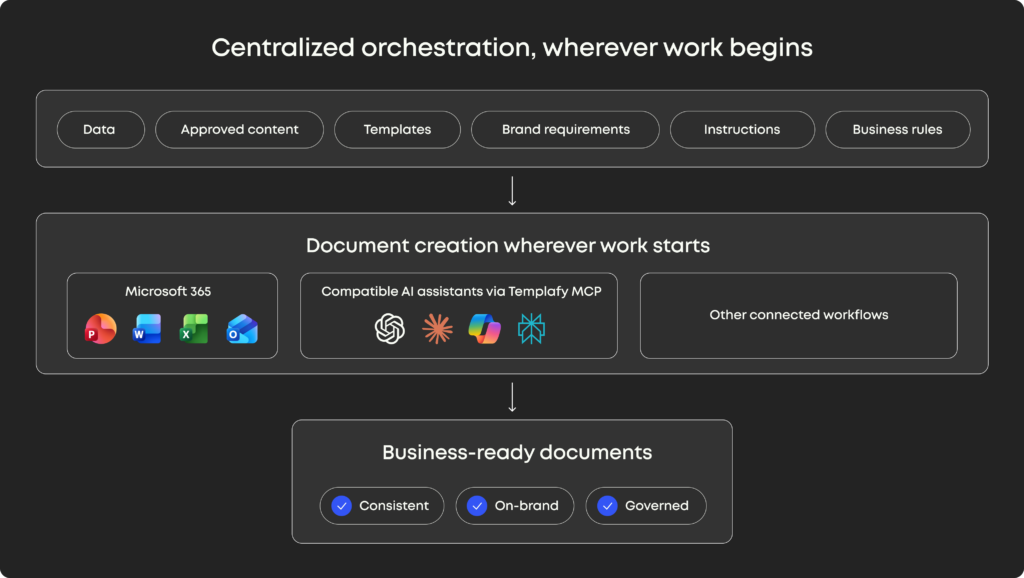
Employees create documents in various applications, from Microsoft 365 to AI assistants and other business systems. The challenge is ensuring they always have access to the right enterprise data, approved content, templates, brand requirements and business rules wherever that work begins.
Templafy provides one centralized orchestration layer for those components, while bringing document generation into the tools employees already use.
Templafy works directly within Microsoft 365, while Templafy MCP extends Document Agents into compatible AI assistants such as ChatGPT, Claude, Copilot and Perplexity.
Employees can start document creation in the tools that suit their workflow, while the enterprise centrally controls the data, content, templates, rules and instructions used to build the document.
3. Templates provide the framework GenAI needs to create “final-form” documents
We think the most effective enterprise strategy combines AI-generated text with traditional component authoring. This allows organizations to use GenAI for the content that benefits from flexibility and personalization, while retaining control over the content that needs to remain consistent or precise.
“While GenAI has introduced the ability to generate content without relying entirely on templates, the most effective enterprise strategy combines both AI-generated text and traditional component authoring (specific text blocks) to balance dynamic flexibility with strict regulatory consistency.”
— Gartner, Innovation Insight: Leverage AI Writing Assistants for Document Creation, 2026
According to the report: “Robust document templates define the background layout, formatting, and metadata fields. Individual templates define structural document hierarchies, outlining the precise sections and naming conventions. Templates ensure that documents are aligned with the organization’s standards.”
The recommendation for organizations is to “Focus on template capabilities, not final output. Prioritize tools that offer strong template designers. The underlying structure, logic and AI prompts used by the templates to create documents are more critical than the final documents itself.”
Templafy’s perspective: Blend GenAI with templates and agents for business-ready output
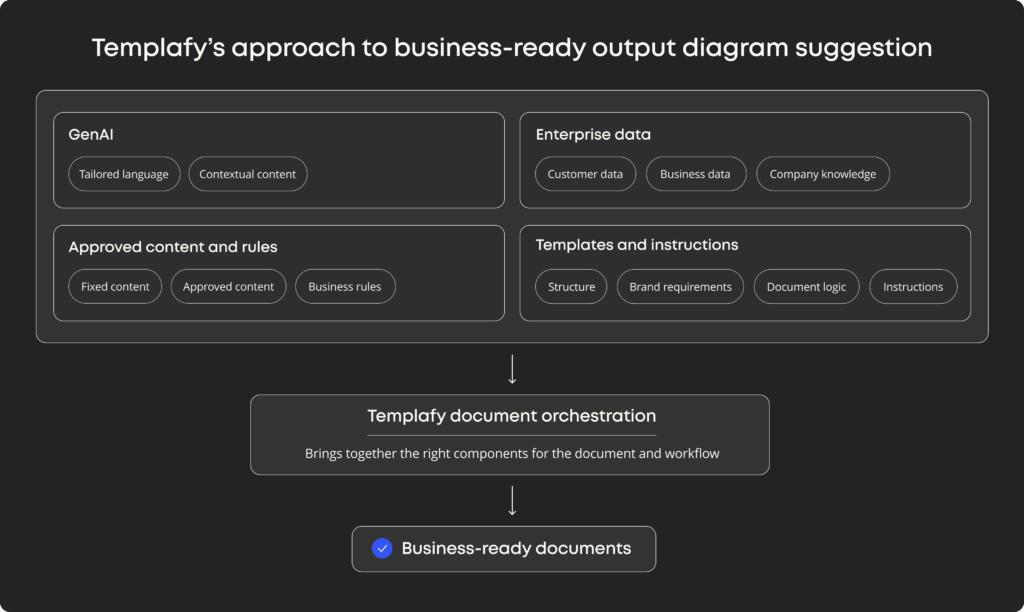
Templafy’s approach is not to ask GenAI to create an entire business document from scratch. It is to put GenAI inside a controlled document-generation process.
Document Agents use GenAI when tailored language adds value. They also bring together enterprise data, approved content, templates, business rules, and instructions to generate and compile the complete document.
This gives teams the flexibility of AI-generated content without losing control over the components that make a document business-ready. Templafy’s patented document-generation technology provides the document-compilation engine that brings generative AI, rules-based automation, enterprise data, centrally managed templates, approved content, and business rules together.
Read the full Gartner report
Gartner clients can access the full report here.
Source: Gartner Report, Innovation Insight: Leverage AI Writing Assistants for Document Creation, By Marko Sillanpaa, July 2026.
Gartner is a trademark of Gartner, Inc. and/or its affiliates.
Gartner does not endorse any company, vendor, product or service depicted in its publications, and does not advise technology users to select only those vendors with the highest ratings or other designation. Gartner publications consist of the opinions of Gartner’s business and technology insights organization and should not be construed as statements of fact. Gartner disclaims all warranties, expressed or implied, with respect to this publication, including any warranties of merchantability or fitness for a particular purpose.
Discover document orchestration with Templafy
Templafy helps enterprises bring GenAI, AI agents, enterprise data, approved content, templates and document controls together within a governed document-generation process.
Book a demo for a personalized walkthrough of the Templafy platform
BLOG
6 common errors hiding in your AI-generated PowerPoint
October, 2026
9 min read
How to keep AI-generated presentations accurate, consistent, and client-ready.
Read more

BLOG
Gartner® just named Templafy a Cool Vendor in 2026 Coolest Vendor Innovations in Digital Workplace Applications
October, 2026
7 min read
AI is everywhere in the enterprise. So why are leaders still finding it difficult to turn adoption into meaningful productivity gains? This is exactly the challenge Gartner examines in its recent report, Coolest Vendor Innovations in Digital Workplace Applications.
Read more
BLOG
Beyond the First Draft: Closing the AI Productivity Gap
October, 2026
6 min read
‘The Business-Ready AI Gap 2026’, Templafy’s new report based on a survey of 2,000 knowledge workers who use AI to create business documents at least once a month in the UK and US, alongside Templafy platform data, reveals the gap between a first AI-generated draft and something that’s ready to share.
Read more