Brand governance vs. brand compliance: The crucial difference in the AI era

7 ways to keep AI-generated documents accurate, current, and on-brand at scale
AI is making business documents much easier to create.
Sales reps can generate proposals before customer meetings. Consultants can draft client presentations. Marketing teams can turn a brief into a deck while the idea is still fresh.
That’s a real productivity win. It also gives brand teams a bigger job to do.
In fact, 71% of organizations were regularly using generative AI in at least one business function in 2025. Marketing and sales were among the most common areas of adoption.
More people are now creating more customer-facing content with more tools. Bynder’s 2026 State of DAM research found that 42% of organizational content is already AI-touched, while 97% of respondents said AI has changed their content operations, including by increasing the risk of off-brand or inconsistent work.
The question for brand teams is becoming harder to avoid: how do you make sure AI-generated documents still sound like you, look like you, and say the right things?
That starts with understanding the difference between brand governance and brand compliance.
Why AI has created a new brand governance challenge
Keeping employees on-brand has always required more than publishing a set of guidelines. People need current templates, approved content, useful examples, and clear direction when they create customer-facing work.
AI raises the stakes because it allows more employees to create more documents, more quickly. It also creates a new dependency: AI needs to be given the right company context before it can produce work that is useful for business.
A sales rep can use judgment when a proposal template looks old. A consultant can ask a colleague whether a customer story is approved. A marketer can spot when a message no longer fits the company’s position.
AI cannot reliably make those calls on its own.
It needs access to approved messaging, current product information, templates, relevant data, required legal content, and clear instructions for the document it is creating. If every employee has to find and provide that context from scratch, your brand consistency depends on individual memory, local files, and prompt-writing skills.
That is the AI equivalent of asking every sales rep to design their own pitch deck every time they need a proposal.
What is the difference between brand governance and brand compliance?
Brand governance and brand compliance are closely connected, but they answer different questions.
Brand governance is how you manage the system behind document creation. Brand compliance is whether the finished document meets the standards your organization has set.
Brand governance manages the system behind document creation
Brand governance covers the people, policies, content, technology, and controls that guide how your brand appears across documents, presentations, reports, email signatures, and other business content.
It can include approved templates, visual assets, current messaging, product descriptions, legal disclaimers, metadata, document policies, ownership rules, permissions, and trusted company knowledge used by AI.
This matters because a document carries much more than a logo. It can contain commercial terms, customer information, product claims, legal language, and messages that shape how your organization is understood.
Brand compliance shows whether the document meets the standard
Brand compliance is visible in the final output. A compliant document uses the standards that apply to its purpose, audience, market, and content.
For a sales proposal, that could mean using the right template, company description, customer information, approved claims, legal disclaimer, imagery, document structure, and tone of voice.
A proposal can look polished and still be unsuitable to send. It may have the correct logo, colors, and template while using outdated pricing, an old product name, or an invented customer statistic.
That is why brand compliance covers the whole document. It includes how the document looks, what it says, which information it uses, and whether it follows the rules that apply.
| Area | Brand Governance | Brand Compliance |
|---|---|---|
| What it manages | The system behind brand consistency | The quality of the finished document or asset |
| Primary focus | Templates, content, ownership, policies, permissions, workflows, and AI instructions | Logos, formatting, messaging, claims, disclaimers, and approved content |
| Key question | How do people and AI access the right information and use it consistently? | Is this document accurate, current, and on-brand? |
| Success looks like | Employees and AI create from a current, governed foundation | Business content meets the required standard |
A simple example shows the difference. Asking employees to use the latest proposal template is a compliance request. Making the latest template available in the tools where they work is governance.
The first relies on people remembering what to do. The second gives them the right starting point.
Why static brand guidelines cannot govern AI-generated documents
Brand guidelines still matter. They give people the visual, verbal, and strategic direction they need to represent the organization well.
But they were designed for people to interpret.
A copywriter can read “sound confident but human,” look at examples, and decide how that applies to a CEO presentation or a sales proposal. A designer can spot a layout that does not feel right. An experienced consultant may know which customer proof point is suitable for a specific industry.
AI needs this guidance in a more usable form.
It needs approved content, trusted knowledge, templates, current data, explicit instructions, and rules that make clear what can flex and what must remain consistent. A brand book stored in a portal can educate people. It cannot, on its own, guide an AI agent creating a proposal before a customer meeting.
AI can make an old problem move faster
Consider a global rebrand. The new visual identity, messaging, and guidelines have all been approved. Then Monday morning arrives.
A salesperson starts from a proposal saved six months ago. A consultant copies slides from an old client deck. A regional team finds a retired template on a shared drive because it is the first one they find.
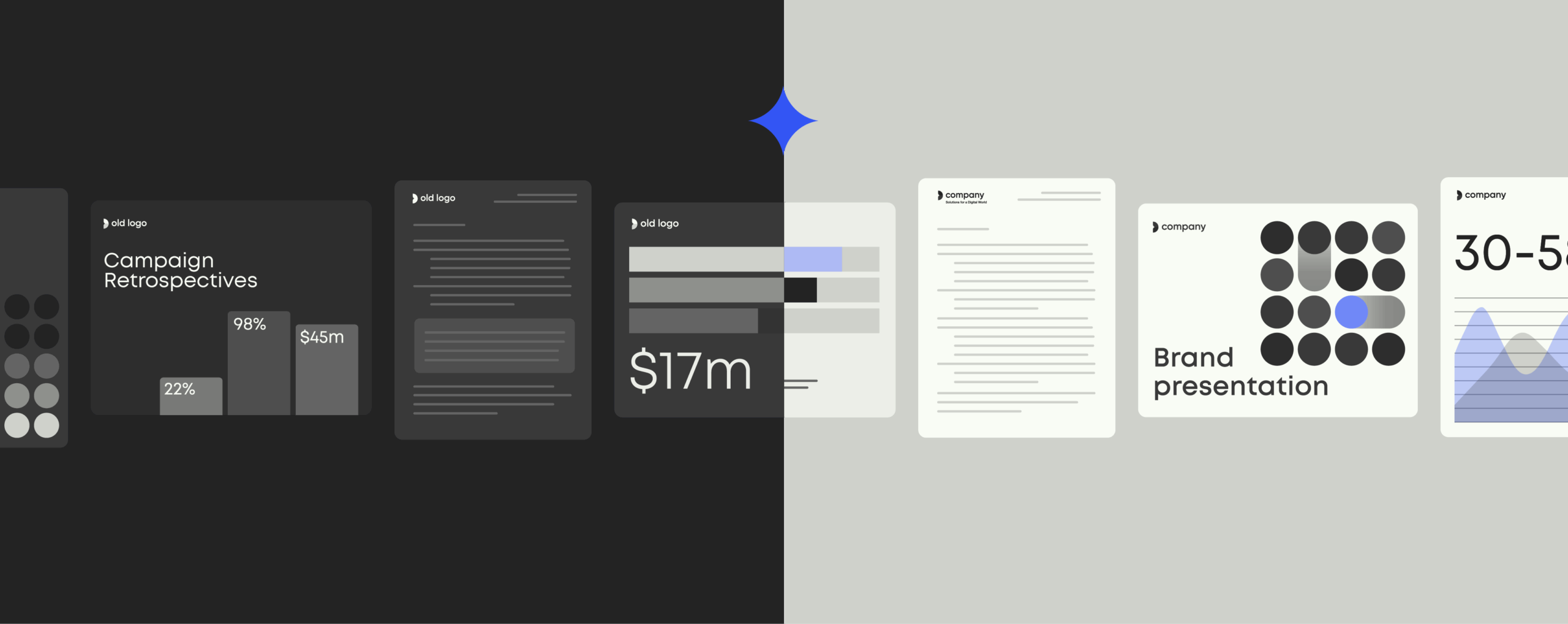
The rebrand is complete centrally. The old brand is still moving through the business.
The same thing happens when legal updates a disclaimer or product marketing changes a product description. People can keep creating new documents from old content if it remains available in the workflow.
AI can accelerate this problem. It can turn an outdated paragraph into a polished new proposal in seconds, giving old information a fresh appearance.
AI needs accurate information as well as brand direction
A document can have the right tone, template, and visual identity while still containing information your business would never approve.
Research cited by Deloitte found that LLM hallucination rates can range from 20% to 30%. Deloitte highlights current data, retrieval practices, testing, and human oversight as important safeguards for reducing inaccurate outputs.
For document creation, this means governing the information behind the output. You need to decide which sources AI can use, who owns them, how they stay current, and when a human needs to validate the result.
3 enterprise barriers to brand consistency at scale
Most enterprises do not lack brand guidelines. They struggle to get the right content, controls, and decision-making into the moment where documents are created.
1. Your approved content is scattered
Templates may sit in one platform, visual assets in another, legal language somewhere else, and old documents on employees’ desktops.
Picture a sales rep preparing for an 8 a.m. meeting. They have a proposal from a similar deal last quarter, a newer template in Teams, product copy in an email, and an AI assistant ready to help.
Which source wins?
Too often, it is whichever one they find first.
That creates risk for people and AI alike. If employees cannot clearly identify the approved source, AI will not reliably know which information to use either. Bynder found that 93% of businesses face content challenges that rule-based automation cannot solve, including finding unauthorized, outdated, or off-brand content at scale.
2. Manual review cannot keep pace with AI generation
Manual review is essential for sensitive, high-value work. It is not a sustainable primary control for every proposal, presentation, report, and email created across a global organization.
AI makes this limitation more obvious. It lets employees generate more content in less time, while brand, marketing, legal, and design teams still have the same number of hours in the day.
You cannot solve an AI-scale creation problem by building an AI-scale review queue.
The goal is to prevent routine issues, such as outdated templates, incorrect disclaimers, and unapproved wording, before a document reaches review. That gives experts more time for the work that needs their judgment.
3. Brand ownership is spread across disconnected teams
Brand may own visual identity. Legal may own disclaimers. Product marketing may own messaging. IT may manage the technology. Sales may own the customer relationship.
That division of expertise makes sense. Each team owns a different part of the picture.
Problems start when those teams manage information in separate places. Employees and AI are left to reconcile multiple sources, interpret conflicting guidance, and decide which version applies.
Good governance connects those responsibilities. It gives people and AI a clear route to current, approved information while allowing each team to maintain ownership of the content and policies it knows best.
7 ways to build AI-ready brand governance
Keep up with AI
Get practical tips and real stories on how AI is changing document work. Stay informed and make smarter choices for your team.
AI-ready brand governance brings trusted content, clear rules, and appropriate human review into document creation. Here are seven practical ways to build it.
1. Assign ownership for every critical content type
Someone should own each important element of the brand, including visual assets, templates, approved messaging, product descriptions, legal language, document policies, and AI instructions.
Ask a simple question: if this information changes tomorrow, who updates the approved version?
If no one can answer quickly, you have found a governance gap. Clear ownership keeps content current as products evolve, campaigns end, laws change, and new messages are approved.
2. Create trusted, current sources of company knowledge
Employees and AI tools need clear answers to a basic question: which source should I use?
Current templates, approved claims, product information, customer proof points, legal content, and reusable document components should be managed as trusted sources rather than scattered across local drives, inboxes, shared folders, and old documents.
AI makes this especially important. A two-year-old product description can look brand new when AI turns it into a polished paragraph in a current proposal.
Old content in, shiny new content out. Still old content.
3. Bring approved content into the creation workflow
The right content should be available where people create documents.
If employees need to leave Word, PowerPoint, or their preferred AI assistant to search several systems, read lengthy guidelines, and manually assemble the correct material, they will find faster workarounds.
When a sales rep asks AI to create a proposal, the approved structure, current product messaging, relevant customer information, and required disclaimer should be available in that workflow.
4. Turn brand principles into usable AI guidance
Most brand guidelines use language that relies on human interpretation. AI needs more concrete direction.
Review your guidance and identify what needs to become approved terminology, preferred and prohibited language, current company descriptions, templates, document structures, visual assets, rules for claims and disclaimers, and guidance for specific markets or document types.
You would not ask every sales rep to build their own pitch deck template. You also should not ask every employee to create their own AI instructions from scratch.
5. Set rules for content that cannot vary
Every document contains elements that should be tailored and elements that should remain consistent.
A customer-specific opening paragraph should change. A required legal disclaimer should not. A proposal should reflect the account strategy, while core product claims need to stay grounded in approved information.
Define which elements are mandatory, which can be adapted, and which rules apply to different regions, audiences, or document types. This gives employees flexibility without leaving business-critical decisions to memory or chance.
6. Match review and controls to document risk
AI-ready governance still needs people. The goal is to use review time where it has the greatest value.
An internal first draft may need light oversight. A customer proposal containing pricing, contractual language, performance claims, or sensitive data may need closer review.
Define which document types, claims, and data require additional checks. This helps teams apply stronger controls where the cost of an error is higher, while allowing lower-risk work to move faster.
7. Build a feedback loop that keeps governance current
Brand governance is never finished. Products launch, legal requirements change, campaigns end, customer needs shift, and teams learn which content works best.
Create a regular feedback loop between the people who define brand standards and the people who use them. Review recurring corrections, common prompt patterns, content requests, approval bottlenecks, and feedback from sales, consulting, marketing, and regional teams.
Then use those insights to improve templates, approved content, policies, and AI instructions. This keeps governance current and gives AI better context for the next task.
How Templafy brings governance into AI document generation
AI can generate a draft quickly. Creating a business-ready document requires the right company context.
That includes approved templates, current content, trusted knowledge, relevant data, document rules, and guidance that tells AI what belongs in a particular proposal, presentation, or report.
Templafy is the agentic document generation platform designed for exactly that challenge. Templafy Document Agents generate, compile, and assemble business documents using the information and context relevant to the task, within a centrally orchestrated document environment.
Depending on the use case, organizations can bring together:
- Approved templates and brand assets
- Current company content and product messaging
- Enterprise data and company knowledge
- Document policies, permissions, and business rules
- Integrations and AI instructions
For a sales proposal, the rep brings customer insight and commercial strategy. Templafy can help ensure the document starts with approved messaging, the right template, relevant company knowledge, and the correct rules.
That gives brand teams more control over the standards that matter, while giving employees a faster path to documents they can use with confidence.
Document Agents give AI the context to create business-ready documents
Imagine two sales reps asking AI the same question: “Create a proposal for this customer.”
One uploads the latest template and current product information. The other attaches last year’s proposal because it is convenient. One includes approved customer proof points. The other assumes the AI already knows them.
Both may get polished results. But the quality and accuracy of the information behind them can be very different.
A governed Document Agent gives both employees the same starting point. The organization can define what every proposal, presentation, or report should draw from before anyone starts prompting. The sales rep then adds the customer-specific context and commercial insight that only they know.
The advantage comes from giving AI the right context before it gets to work. That is how enterprises can create reliable, repeatable document quality as AI use expands across teams and workflows.
Governance gives your brand room to scale
Brand compliance tells you whether an individual document meets your standards. Brand governance gives people and AI a dependable way to create that quality again and again.
Your sales team should not have to hunt for the latest proposal template. Your consultants should not need to guess which customer story is approved. Your marketers should not have to rebuild brand context every time they use AI. Your brand team should not have to catch the same avoidable mistakes in every review cycle.
Good governance brings the right templates, messaging, company knowledge, and rules into the moment of creation. People spend less time searching, checking, and fixing. They can spend more time on the customer, the opportunity, and the work that needs their judgment.
When AI has the right context from the start, it can help your organization create documents that are accurate, current, and unmistakably yours.
Get your brand ready for AI
What does your brand look like when its guidelines need to work for AI as well as people?
In Templafy’s on-demand webinar, The future of brand governance: Building AI that humans love and brands can trust, Thomas Marzano, Agentic Branding Architect and Founder of Marzano Consulting, joins Templafy to explore how enterprises can prepare their brands for an AI-driven future.
You will learn how to turn human-readable brand guidance into machine-usable structures, organize trusted brand knowledge, and build governance into the workflows where AI creates content.
Catch the webinar on demand to learn how to build a brand that works for both humans and AI.
BLOG
6 common errors hiding in your AI-generated PowerPoint
October, 2026
9 min read
How to keep AI-generated presentations accurate, consistent, and client-ready.
Read more

BLOG
Gartner® just named Templafy a Cool Vendor in 2026 Coolest Vendor Innovations in Digital Workplace Applications
October, 2026
7 min read
AI is everywhere in the enterprise. So why are leaders still finding it difficult to turn adoption into meaningful productivity gains? This is exactly the challenge Gartner examines in its recent report, Coolest Vendor Innovations in Digital Workplace Applications.
Read more
BLOG
Beyond the First Draft: Closing the AI Productivity Gap
October, 2026
6 min read
‘The Business-Ready AI Gap 2026’, Templafy’s new report based on a survey of 2,000 knowledge workers who use AI to create business documents at least once a month in the UK and US, alongside Templafy platform data, reveals the gap between a first AI-generated draft and something that’s ready to share.
Read more