TEMPLAFY MCP
Bring Templafy to the AI Assistants you already use
Create business presentations with your company knowledge, templates, and content, directly from your preferred AI assistant.
How to get AI to generate client-ready documents with MCP

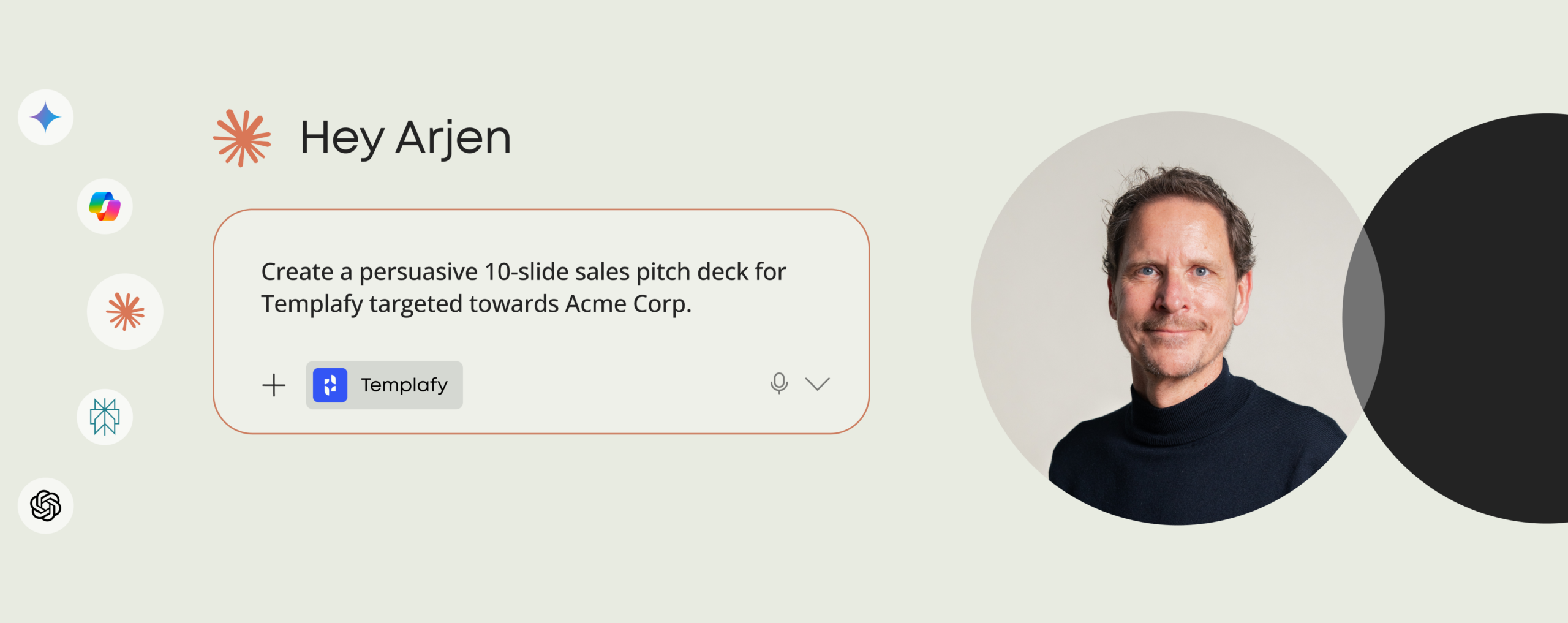
Want your AI tools to produce enterprise‑quality documents at scale? Templafy’s MCP Product Director Arjen shares how.
Another three-letter acronym is taking the AI world by storm. And this one’s not just a LinkedIn buzzword. MCP (Model Context Protocol) is a cracking piece of code that gives organizations a universal way to connect their AI platforms to the rest of their tech stack, without needing to build a custom integration every time.
It is a huge win for end users, developers, and the organization as a whole. It means more accurate, company‑approved AI outputs, far less time spent editing content, and more ways for teams to get back to the work that matters.
We’ve taken full advantage of this open standard with Templafy MCP, which lets teams access Templafy’s document generation engine from inside their preferred AI chat interfaces. Instead of starting in Word or PowerPoint and juggling folders and tabs, end users can ask AI for a proposal, report, or board presentation, and get back a complete, accurate, branded Microsoft file that is ready to send.
Behind the scenes, there’s a whole lot more going on.
We grilled Arjen, Product Director for Templafy MCP, to unpack what this nifty piece of code actually does, why enterprises should care, and how it’s helping organizations generate even better documents at scale.
What is MCP and why does it matter for enterprise AI?
1. How would you explain what Templafy MCP actually does, for someone who hasn’t followed MCP closely?
The AI assistants people already use are great at drafting ideas, but on their own they often hand back generic, text-only or HTML outputs. They’re off-brand, hard to collaborate on, and they don’t know your templates, assets, or document rules.
MCP is an open standard you can think of as a universal plug for AI tools. It gives assistants a repeatable way to call external systems without your developers needing to build custom integrations for each one.
Templafy MCP is the bridge between those assistants and Templafy’s document generation platform. It lets your AI of choice call in the help of Templafy, which returns a finished, on-brand presentation or document in a real Microsoft format.
To the user, it just feels like asking ChatGPT, Claude, Copilot, or another AI for a proposal or deck and getting a client-ready file back in the same interface. So the productivity and adoption wins are clear.
2. What was the internal moment where the team said “we need to build this”? Was there a specific customer pain that made it obvious?
It came down to a gap we kept hearing about from enterprise customers. They had invested in AI assistants, but the drafts people produced needed so much cleanup that the promised time savings disappeared.
Marketing and brand teams were nervous about losing control over anything AI touched. IT leaders wanted real ROI from their AI investments, plus the freedom to switch platforms later without rebuilding everything.
At the same time, Templafy had already spent years building the document orchestration platform. The content libraries, rules-based automation, and document agents were there. The obvious next step was to expose that platform through the open protocol AI tools were converging on, instead of betting customers on a single assistant.
3. Templafy has always been about document governance and brand compliance. Is MCP an evolution of that, or something new?
It is a natural evolution. The mission has not changed. Templafy is still focused on helping enterprises produce consistent, high-quality, on-brand, compliant documents at scale. With MCP, the same controls extend into the AI assistant the user is already working in.
Templafy can still be your central platform to orchestrate all the documents created across the organization. MCP becomes a new front door to the same orchestration platform.
How does Templafy MCP work?
Keep up with AI
Get practical tips and real stories on how AI is changing document work. Stay informed and make smarter choices for your team.
4. When someone uses Templafy MCP through Claude or Copilot, what is actually happening under the hood?
More than it looks from the outside. Based on the user’s prompt, the AI assistant discovers Templafy’s tools and selects a document agent that is most suitable to build the intended documents. Users also get to choose a theme to build their documents, for example a client pitch or a quarterly business review.
The assistant then sends that structured request through MCP to Templafy’s existing document generation platform. Templafy document agent applies the approved layouts, fonts, business rules, and managed content behind the scenes.
The platform renders a native PowerPoint, or PDF file and sends a preview and links back into the AI assistant interface. The MCP server itself is a pass-through. It does not store documents or content.
For customers, that means the same backend, data boundaries, and contracts they already rely on. MCP just adds AI assistants as new, governed starting point.
5. One concern with AI-generated documents is that they look generic or off-brand. How does MCP solve that in practice?
Generic AI output is usually content rebuilt from scratch every time. It tends to be text-only, with no layout system, brand rules, or governance.
With Templafy MCP, the AI proposes the content, but Templafy owns the rendering. The platform applies approved layouts, company templates, existing content blocks, the correct fonts and colors, icons and images, and centrally managed disclaimers.
The result is a native, editable file that already looks like your firm made it. People are not rebuilding AI drafts by hand before they can send them to a client, which is where the real time savings and quality gains show up.
6. What surprised you most during the build or early testing?
Two things. The first was the variability across AI assistants. On paper, they all speak the same MCP language, but in practice they behave differently. Some assistants render rich responses; others silently drop elements.
A lot of the engineering work went into detecting which assistant is calling and tailoring the response, so it gets an output it can actually display, with a clean fallback when it cannot.
The second surprise was the impact on both cost and quality. Once Templafy handled structure and visual rendering, token usage dropped significantly. In internal benchmarks, the team saw reductions of roughly 50% to 60% on a representative deck, while the quality of the output improved, because the model was no longer trying to reconstruct layout and styling from scratch, and many best-practice slides and visuals were getting inserted from the library.
7. Where does Templafy MCP end and the AI assistant begin? How should enterprises think about what each part owns?
It is a clear split. The AI assistant owns the conversation and the reasoning. It understands the request, does the research, drafts the content, and structures the storyline. That is the customer’s relationship and contract with their AI vendor.
Templafy owns the last mile. That includes governance, brand and layout, approved content, and the finished file delivered in Microsoft formats. That is the part enterprises need to control to make AI safe and useful at scale.
In simple terms, the AI is the researcher. Templafy is the document builder and governance layer that turns AI output into business-ready documents.

Agentic document generation for professional teams
AI makes everyone faster.
Document Agents help your team perform.
Which enterprises benefit most from MCP?
8. Which customer profiles or use cases are seeing the most immediate value from MCP?
The strongest fit is document-heavy, brand-sensitive, often regulated work. That includes professional services, consulting, and financial services firms.
Typical use cases are proposals, pitch decks, QBRs, client reports, RFP responses, and audit documents. In these workflows, the combination of speed, precision, and control really matters.
More broadly, any enterprise that has already invested in an AI assistant and has teams creating high-value documents that must be accurate and on-brand is a good fit. If people are pasting AI drafts into templates by hand or arriving with web-page-like outputs that do not match company standards, Templafy MCP is relevant.
9. There is a lot of noise around AI integrations. What makes Templafy’s approach different from someone just standing up an MCP server?
Standing up an MCP endpoint is the easy part. The governed content platform behind it is the hard part, and that is where Templafy is differentiated.
Templafy brings years of investment in asset and document libraries, rules-based automation, and document agents. It generates real, native PowerPoint and Word files built from the customer’s own corporate templates and rules, under the user’s own identity and permissions, not generic outputs from a shared service account.
Because MCP uses the same backend, data residency, and contracts customers already have with Templafy, it becomes an extension of their existing document governance, not a bolt-on. An MCP server without that governed platform underneath is essentially a thin pipe to nowhere.
What’s next for MCP and AI document generation?
10. Where does this go in the next 12 to 18 months? What should customers be most excited about?
In the near future, Templafy is focused on hardening compatibility across more AI assistants, including Copilot, Perplexity, Gemini, and Glean, beyond the current support for Claude Cowork and ChatGPT.
The roadmap also includes a Word agent and a shift from pure creation to edit flows, so users can revise and refine documents in place from within the AI conversation, rather than only generating new files each time.
The exciting part for customers is that the AI assistants they already use become places to produce and edit finished, on-brand, business-ready documents. With Templafy as a central document orchestration layer, enterprises can govern rules, structures, and branding across Microsoft 365, CRMs, document management systems, sales enablement platforms, and now AI tools, from a single control layer.
Ready to generate enterprise-ready documents from any AI platform?
Like everything we do, Templafy MCP is all about adapting to the way your teams actually create documents.
AI assistants are quickly becoming the place where work begins. Templafy ensures that the documents that come out on the other side are accurate, compliant, and ready for business.
Book a demo with our AI document experts to see how MCP helps enterprises generate client-ready documents from any AI platform.

BLOG
The AI productivity paradox: Why AI drafts still take hours to finish
October, 2026
12 min read
AI is everywhere in the workplace. But despite widespread adoption, enterprises are still struggling to turn AI-generated content into real business value. So what's holding businesses back?
Read more

BLOG
Templafy Talks: 3 takeaways for orchestrating AI document creation
October, 2026
8 min read
How to scale AI without losing control of document quality, compliance, or costs.
Read more
BLOG
6 common errors hiding in your AI-generated PowerPoint
October, 2026
9 min read
How to keep AI-generated presentations accurate, consistent, and client-ready.
Read more