
Agentic document generation for professional teams
AI makes everyone faster.
Document Agents help your team perform.
AI hype doesn’t drive adoption – it’s all about governance and workflows

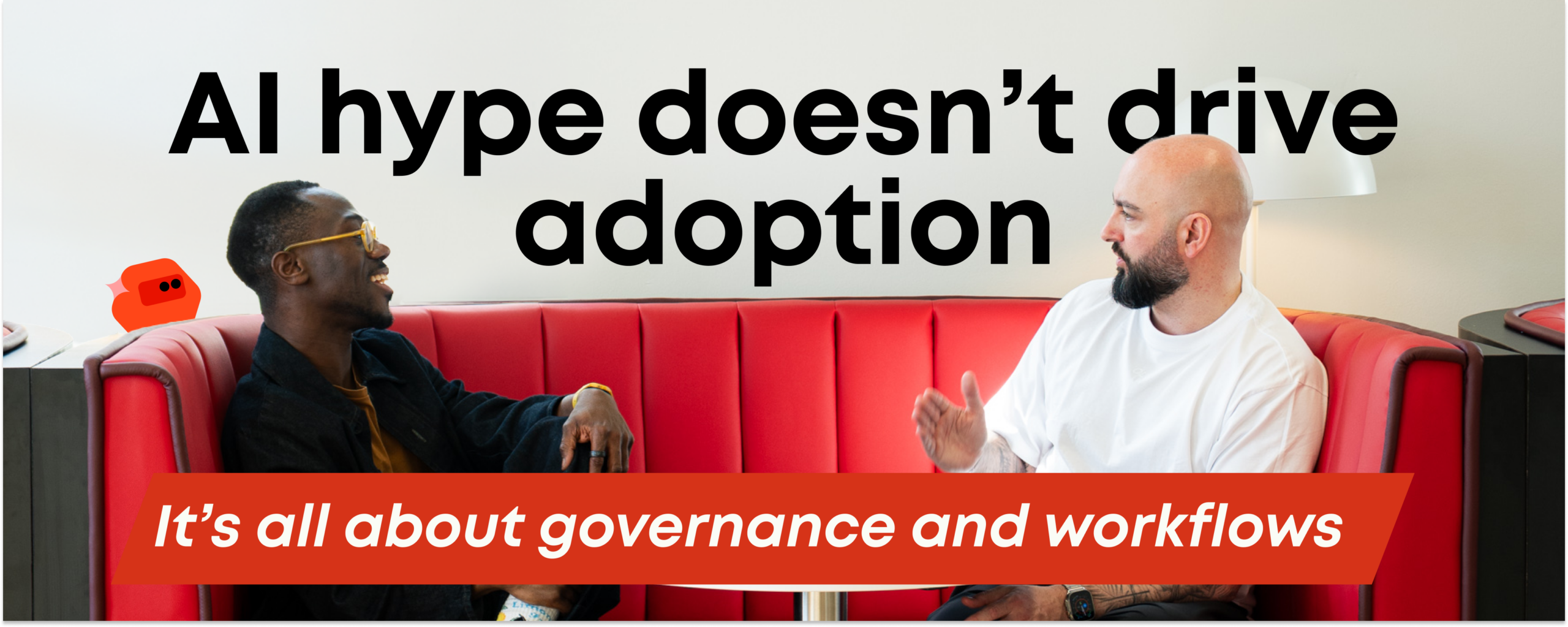
Leading AI advisor Tey Bannerman on moving AI from experiment to everyday use
If 1 in 10 cars will be self-driving by 2030, why are enterprises still struggling to operationalize AI across everyday workflows?
It’s all about choosing the right workflows and adding the right governance, according to Tey Bannerman. And as a former McKinsey & Company Partner and leading enterprise AI advisor, he knows what moves AI initiatives from pilot to measurable business impact.
In this session, Tey shares his human-centered approach to AI implementation that helps enterprises bridge the gap between AI hype and real operational change.
Here are the highlights. Watch the full session here.
“Almost every organization is asking: what do we do about AI, and how do we not get it wrong? There’s a lot of noise out there. I help them make sense of it in their specific context.”

Tey Bannerman
AI advisor and former McKinsey Partner
The AI adoption gap: where’s the ROI?
Walk into almost any enterprise today and you’ll find AI everywhere: writing emails, summarizing meetings, and automating workflows. Not to mention the under-the-table apps helping marketing and sales teams draft just about everything.
But despite more than 70% of organizations now using GenAI in at least one business function, more than 80% report no tangible enterprise-level EBIT impact, according to Mckinsey.
Teams might have access to AI. But it isn’t delivering the kind of operational change and business impact we all expected.
| 80%+ of organizations report no tangible enterprise-level EBIT impact from GenAI | Only 1% of executives describe their GenAI rollouts as “mature” | Only 21% have redesigned workflows to get the most out of GenAI |
Source: Mckinsey, The state of AI: How organizations are rewiring to capture value
3 reasons why enterprise AI investments stall
Keep up with AI
Get practical tips and real stories on how AI is changing document work. Stay informed and make smarter choices for your team.
1. Most workflows aren’t ready for AI
When asked which workflows AI can’t automate, Tey had a simple answer: “Most of them.”
The instinct is to add AI to everything: an LLM here, a chatbot there, a Copilot licence for the whole org. But some workflows need human judgment, while others need the precision of more traditional technology, like rules-based automation or structured systems.
“You really need to be thoughtful about what’s the right constellation, using AI models and tools, having humans, or just using more traditional technology. It’s not one or the other.”
Tey Bannerman
AI advisor and former McKinsey Partner
2. Companies buy tools before defining the problem
Leadership see a tool that looks powerful, bring it in fast, and figure out the use case later.
Without clear goals, workflows, and guardrails, AI ends up disconnected from how the business actually operates.
In fact, McKinsey found that two practices have the biggest impact on the bottom line: tracking well-defined KPIs for GenAI solutions, and building a clear road map to drive adoption.
“The first mistake a lot of companies make is they’ll see a tool or a solution and go, ‘We need to bring that in,’ without clarity on why. Really understand what you’re trying to solve first.”
Tey Bannerman
AI advisor and former McKinsey Partner
3. Companies forget the human side of adoption
Even with the right tools in place, AI initiatives stall when the technology doesn’t fit naturally into the way people already work.
Successful adoption depends on making AI easy to use, easy to trust, and embedded into existing workflows. Otherwise, teams fall back on familiar ways of working.
“I’ve seen a lot of organisations make a big decision about bringing in tools, and then people either don’t use them or don’t use them correctly because the culture internally is, ‘We have a way of doing things—there’s no need to change.’
If people are apprehensive because they’re going to be looked down upon or get in trouble, then you haven’t built the right environment for people to go, ‘I want to try this—and I have a license to try this.’”
Tey Bannerman
AI advisor and former McKinsey Partner
4 ways to turn AI investment into real results
1. Use AI to cut repetitive busywork
The clearest ROI from AI is time. Freeing your highly skilled people from repetitive tasks like data entry and document creation creates more space for high-value, strategic work.
“Where I’ve seen AI tools really shine is helping people make sense of a lot of information, condensing it into the right story to tell. And then cutting out the busy work.
I’ve spent hours tweaking little things on slides and changing designs. That’s time I could have spent thinking about the storyline, the narrative flow, who’s the client, not moving a piece of text one pixel to the left.”
Tey Bannerman
AI advisor and former McKinsey Partner
2. Build governance in from the start
If every team is creating with AI, how do you keep outputs consistent, compliant, and on-brand?
Before rolling out any AI tool, make sure it connects to your existing systems, content, and workflows. Without that foundation, AI outputs quickly become fragmented and difficult to control across teams.
“A lot of companies I work with have so many people using a range of AI tools, to write emails, create presentations. And they’ve started to go, ‘Wait. We’re losing control.’ Whether it’s brand consistency, tone of voice, or the visual elements that aren’t there. They’re seeing potential damage to the brand.”
Tey Bannerman
AI advisor and former McKinsey Partner
3. Clean up your data first
As the saying goes: garbage in, garbage out.
It’s pretty likely that your enterprise is sitting on a vast repository of outdated, off-brand, or fragmented data. Before deploying AI to any workflow, ask: what are you feeding it?
“The best proxy for good data is: what data are people actively using today, and using meaningfully? A lot of companies have big databases where no one has touched anything for years. If people aren’t using it, you have no assurances on its quality.
A light audit is often all you need: what do we have, where is it stored, is it actually usable?”
Tey Bannerman
AI advisor and former McKinsey Partner
4. Deploy AI agents with guardrails
AI agents are the next frontier in AI innovation, according to Mckinsey. And leading enterprises are already using them to handle core workflows like document creation, customer support, and recruitment.
Tey’s advice? Earn the right to go there first.
That means choosing data-backed use cases and prioritizing governance.
“A lot of companies are rushing toward agentic AI without first establishing the foundations of good principles and culture around even basic AI tools.
A single-digit percentage of companies using AI tools are actually seeing any real value from them. Let’s make sure we lay the right foundations first.”
Tey Bannerman
AI advisor and former McKinsey Partner
Put people first: Tey’s 3-step framework for AI adoption
Tey is passionate about a human-centred approach to AI. And the potential business impact of getting teams genuinely behind the tools is huge.
When employees feel ownership over the AI they use, initiatives have the best chance of taking off and transforming the way people work. It frees up time for more strategic work and drives productivity and timesaving gains that leadership can measure.
Here’s his three-step framework.
1. Co-design the rollout before you buy anything
“Co-design the implementation with the people who are going to be using it, prior to purchase. When people feel like they’ve designed something, they’re far more likely to adopt it because they felt like they were part of the process.”
Tey Bannerman
AI advisor and former McKinsey Partner
2. Share stories of where it’s working
“Every two weeks, send out a short email: ‘Look at what John did with this tool. It saved him X hours.’ Then people start to see that it’s actually working for others, and they’re more likely to try it themselves.”
Tey Bannerman
AI advisor and former McKinsey Partner
3. Build a feedback loop for wins, not just problems
“Create a mechanism for people to give feedback, but it shouldn’t just be for issues. You also want to capture the wins, cool ways people have found to use the tool, and share those out to the rest of the company.”
Tey Bannerman
AI advisor and former McKinsey Partner
Why document workflows are the best place to invest in AI
So what does all of this look like in practice?
Enterprises need AI that works inside existing employee workflows, takes over the busywork so teams can get back to strategic work, and stays governed so control never leaves the organization.
There’s no better place to start than document creation. Every professional’s working day is full of it, and a huge chunk of it is repetitive. That means the potential productivity gains and time savings are significant. And improving the quality and consistency of documents, especially for sales teams, has a direct impact on revenue.
But for enterprises that need accuracy, consistency, and branding across every document, generic AI tools don’t provide the governance necessary.
That’s exactly where Templafy comes in.
How Templafy’s AI document agents operationalize AI across the enterprise
There’s a reason 4 million users across 800 leading enterprises generate documents with Templafy, including Big Four firms like KPMG and BDO, and organizations where accuracy, compliance, and security are non-negotiable.
Templafy is the AI-powered document generation platform that works natively inside Microsoft 365 and the tools your teams already use. No new software. No new habits. Just AI built into the workflow that’s already there.
Because Templafy connects with your entire content ecosystem, including your DAM, CRM, SharePoint, and Salesforce, every document your teams generate automatically pulls in the right templates and up-to-date data.
The result? AI that scales across every department, every document type, every team, without the risk.
See all of Templafy’s integrations.
AI agents with governance built in
While most AI tools just generate text, Templafy’s AI document agents generate entire documents and presentations from a simple prompt. They’re connected to everything they need to carry out the full workflow: your data, brand rules, approved content, and compliance requirements. All from inside Microsoft.
And because every team across every department creates documents, the impact is company-wide.
Watch the video to see agent-powered document creation in action.
The secure way to scale AI
Security isn’t a feature at Templafy. It’s the foundation. Templafy is SOC 2, SOC 3, ISO 27001, ISO 27017, and GDPR compliant, and Microsoft 365 App Certified, meeting the highest standards for data protection, security, and compliance.
Templafy’s AI runs on Microsoft Azure OpenAI or your own trusted AI model, so your data is protected at every step. Role-based access controls, encrypted data at rest and in transit, and full activity logs give IT and InfoSec teams the visibility they need.
Read more about Templafy’s security.
How leading organizations get measurable ROI with Templafy
“Last year, we generated over 120,000 documents through Templafy, saving us about $1.65 million.”

Brion Hendry
Partner, BDO
“With Templafy, we’ve found the key to the productivity promise of AI without the risk. It’s simple to manage, easy to use, and helps everyone deliver reliable business content much faster.”

Kaisa Nummela
Portfolio Owner, Tietoevry
“The fastest I could have given my client a well-thought-out PowerPoint was at least five days. Templafy has probably cut that in half.”

Alex Steging
VP/GM, Material+
“We’re never asked to report ROI on Templafy because it’s far too obvious how essential an investment it is.”

Sebastien Dubrelle
CIO, Moore
Read more about Templafy’s customer wins.
From prompt to PowerPoint for professionals
Ready to try it for yourself? Templafy’s free PowerPoint agent turns a single prompt into a complete, professional deck. No credit card, no download required.
The best way to see what Templafy can really do for your organization is to speak with one of our document experts.
Book a demo to discover how Templafy could scale AI document generation across your organization.

BLOG
The AI productivity paradox: Why AI drafts still take hours to finish
October, 2026
12 min read
AI is everywhere in the workplace. But despite widespread adoption, enterprises are still struggling to turn AI-generated content into real business value. So what's holding businesses back?
Read more

BLOG
Templafy Talks: 3 takeaways for orchestrating AI document creation
October, 2026
8 min read
How to scale AI without losing control of document quality, compliance, or costs.
Read more
BLOG
6 common errors hiding in your AI-generated PowerPoint
October, 2026
9 min read
How to keep AI-generated presentations accurate, consistent, and client-ready.
Read more