
Agentic document generation for professional teams
AI makes everyone faster.
Document Agents help your team perform.
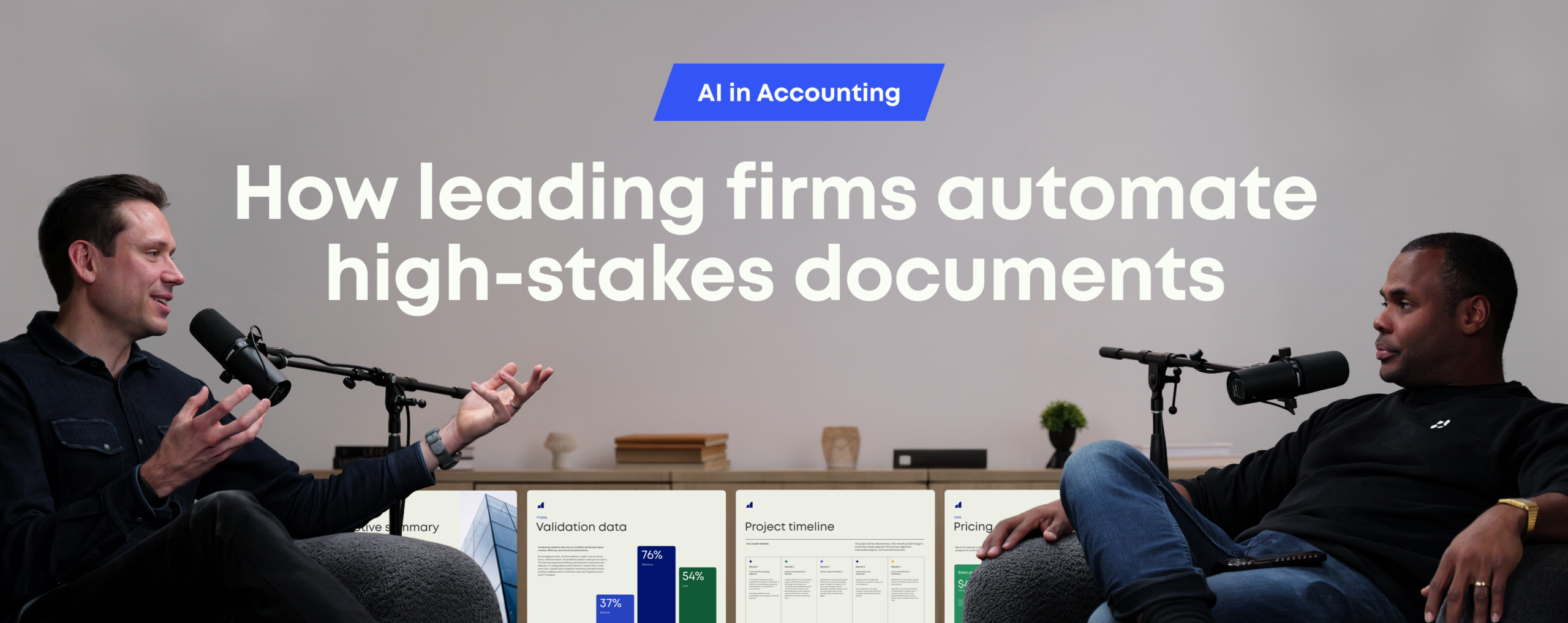
AI in accounting: How leading firms automate high-stakes documents
How the big four and beyond are governing AI at scale
“Everything demos well. The question is, does it work?”

Jean-Marc Chanoine
Chief Sales Officer, Templafy
Sure, generic AI tools might be able to draft parts of an audit report, engagement letter, or client deliverable. But you wouldn’t stake your firm’s compliance, professional liability, or reputation on it.
In professional services, AI ROI doesn’t come from flashy features. It comes from accurate outputs, clean data, and governed workflows.
In this conversation, two experts who work with leading professional services organizations, from KPMG, EY, PwC, and Deloitte to mid-market firms, break down how accounting teams are reaping the productivity benefits of AI without the risk.
Watch the full conversation here
Speakers
Jean-Marc Chanoine, Chief Sales Officer, Americas, Templafy
Jean-Marc works with the world’s leading accounting and professional services firms on governed document automation at enterprise scale.
Chris Kavcsak, Area President, Ascend
Chris leads growth and operations at Ascend, one of the fastest-growing middle-market accounting platforms in the US, helping firms modernize, grow, and build the foundations they need to scale with technology & AI.
Takeaway 1: Governance is the whole strategy
Professional services firms are under more pressure than ever. Between talent shortages, rising regulatory demands, and workloads that keep growing, the case for AI is obvious. But so is the risk.
In an industry where a single typo can trigger regulatory action or damage a client relationship, speed is nothing without governance and control.
Generic AI tools can only get you 80% of the way
Tools like ChatGPT, Claude, and Copilot don’t know your firm’s approved clause library. They can’t verify a figure against your source data. They have no way of knowing which regulatory phrasing is required on page 12 of an audit report.
That gap between “looks right” and “is right” is where they break down. And in professional services, it’s where the cost of getting it wrong is highest. Audit reports, tax filings, and engagement letters are signed off by people who carry personal liability for every word.
“The partners signing off on those audit reports or the tax return, the liability is on them. It’s critically important that the quality is right and that they’re comfortable signing those papers. Because they’re the ones that are liable.”

Chris Kavcsak
Area President, Ascend
That pressure only grows as AI moves toward agentic workflows, where it takes over full processes rather than just supporting them.
“Right now, you have AI as an assistant. But we keep talking about agentic AI taking over full workflows, and the liability is still going to rest with the partner, with the lawyer actually signing off. Are you willing to put your license on the line without having the tooling for the quality checks?”
Chris Kavcsak
Area President, Ascend
The “last mile” needs rules-based automation
The key is knowing when to use AI, and when to use something more reliable. Rules-based automation handles the parts that can’t vary: approved clauses, verified data, mandatory disclosures, and regulated phrasing that has to be exactly right every time.
That combination of AI and rules-based controls is what closes the gap. It lets firms move fast on document creation without sacrificing the accuracy that professionals need to sign off with confidence.
“LLM platforms like ChatGPT or Claude are really good at getting to 80%. Where Templafy drives that last mile of efficiency is in that final 20% of content creation, which is extremely hard.”
Jean-Marc Chanoine
Chief Sales Officer, Templafy
Research from MIT Sloan found that accountants using AI shifted 8.5% of their time away from manual data entry toward higher-value work, and closed their monthly books 7.5 days faster. But the firms seeing the biggest gains were the ones where experienced professionals stayed in control of the output.
“The key question we ask is: which parts of this document can be AI, and which parts need to be rules-based? That orchestration is how we eliminate a lot of manual document work without sacrificing accuracy.”
Jean-Marc Chanoine,
Chief Sales Officer, Templafy
Takeaway 2: Standardization before automation
Keep up with AI
Get practical tips and real stories on how AI is changing document work. Stay informed and make smarter choices for your team.
Before a firm can automate any workflow, it needs to agree on what that workflow should actually look like. In professional services, that’s harder than it sounds.
Processes vary by team, by partner, by office. Data is spread across multiple systems. Without a single source of truth, even the best AI tool has nothing solid to build on.
Define what “good” looks like first
What does a good engagement letter look like? What does an audit report need to contain? What does approved language look like across teams? Without clarity on best practice, AI just automates inconsistency at scale.
“Within a firm there might be 15 chiefs with different opinions, and 20 partners with a whole different view on what the solution should do.”
Jean-Marc Chanoine
Chief Sales Officer, Templafy
This part’s important: the right technology partner helps you navigate that complexity. They don’t just hand over a platform. They work with your stakeholders, align people across practice areas, and make sure the solution fits how your firm actually operates.
Clean your data before you deploy anything
As the saying goes: garbage in, garbage out.
When client information, templates, approved content, and process logic are scattered across six different systems, AI has no reliable source of truth to work from. The output reflects the mess underneath it.
“You can’t deploy an agent in a world with disaggregated data. Before you can deploy agentic AI, you have to have a source of truth when it comes to process.”
Jean-Marc Chanoine
Chief Sales Officer, Templafy
Getting data in order means consolidating systems, deciding which sources take precedence, and making sure everything AI touches is accurate, current, and approved. It’s unglamorous work. But it’s what separates firms that see real results from those still running pilots a year later.
“You don’t have an AI strategy if you don’t have a data strategy. You can’t just drag-and-drop AI into a firm when the data might be in six different systems. How do you stitch that together in a way that’s workable and effective?”
Chris Kavcsak
Area President, Ascend
Takeaway 3: Document automation delivers the fastest ROI
Every firm produces the same core documents: audit reports, engagement letters, tax filings, client presentations. It’s high-volume, mandatory work. And most of it is still done by hand.
The biggest productivity drain is in the final document
The hard thinking is done. The audit work is complete. The numbers are checked. And then someone still spends hours putting the final document together, formatting, restructuring, hunting for the right approved text to drop into page 27.
That’s the bottleneck. And it’s where the most experienced people in the room are losing the most time.
“A lot of the calculations have been done, the audit work has been done, the interviews have been done, and really some of the toughest parts are actually putting together the final output. Organizations that have Templafy, their employees’ lives are better because they have a solution that can eliminate moving boxes around in PowerPoint, or injecting a specific piece of text on page 27.”
Jean-Marc Chanoine
Chief Sales Officer, Templafy
That’s the value of platforms like Templafy, and why document automation has become the most immediate, most measurable AI deployment in professional services.
Templafy’s AI document agent platform turns a prompt into a fully compliant, correctly formatted document, trained on your firm’s own rules, templates, and approved content, cutting out the manual assembly work between finished analysis and final deliverable.
How BDO Canada saved $1.65 million in one year by automating document creation
BDO Canada was dealing with inconsistent branding, outdated technology, and time-consuming manual document processes across hundreds of offices. After implementing Templafy, they generated over 120,000 documents in a single year, standardized every engagement letter firm-wide, and saved $1.65 million in document creation time.
Governed AI raises quality across the board
When every document comes from a governed source of truth, quality goes up across the board.
Junior team members produce work that matches senior standards. Review cycles get shorter. And senior staff get time back for the work that needs real human judgment: client relationships, strategic thinking, advisory work.
“Even someone who wasn’t great at creating a presentation can now produce something that’s nearly perfect and exactly on brand. Yes, there’s a time saving, but what about the components that increase quality of life for employees? That’s a huge part of the ROI.”
Jean-Marc Chanoine
Chief Sales Officer, Templafy
“How do we enable our people to focus on the highest-value activities, the client service, the advisory, and actually give them a better quality of life? That’s the goal.”
Chris Kavcsak
Area President, Ascend
Start narrow, then scale
The firms seeing the strongest results don’t try to fix everything at once. Start with workflows that are truly universal, like engagement letters. Every part of the business produces them, they follow a clear structure, and getting them right matters. Get that workflow right, prove the value, then build from there.
“Firms are most successful when they tackle very well-defined problems within a subset of the population, instead of a monolith solution that’s supposed to solve everything.”
Jean-Marc Chanoine
Chief Sales Officer, Templafy
How Everest Group saves 1,200+ working hours annually by centralizing document management
“Templafy has made our templates much more accessible and much easier to update. It has clearly become our source of truth—if it’s in Templafy, it’s correct.”

Elizabeth Boudrie
Senior Vice President, Everest Group
How to get started with document automation
There’s a reason 800+ leading global enterprises automate their most high-stakes documents with Templafy. Its AI-agent-powered platform gives accounting and professional services firms the rigorous control they need to keep every output accurate, compliant, and on brand, every time.
Templafy connects your entire data and tech stack, from CRM systems like Salesforce and document management systems like iManage and NetDocuments, to DAM platforms like Bynder and Brandfolder. Live data flows directly into your documents so nothing has to be typed twice.
Read more about Templafy’s integrations
And because it works natively inside the tools your teams already use, Word, PowerPoint, Excel, Outlook, and Google Workspace, there’s nothing new to learn and no reason to wait.
Your model, your data, Templafy’s security-first approach to eliminating manual document work.
Read more about Templafy’s enterprise-scale AI security
Put it to the test
What if your team could go from a simple prompt to a complete, client-ready presentation in seconds—without ever leaving PowerPoint?
We’ve created a free version of our PowerPoint agent so you can see it in action.
Templafy’s document agents are trained on your firm’s templates, brand rules, and approved content. Type a prompt. Get a finished, on-brand deck, built to your exact standards and ready to send.
Try prompt to PowerPoint for free or book a demo to see document agents across your full stack.

BLOG
Templafy Talks: 3 takeaways for orchestrating AI document creation
October, 2026
8 min read
How to scale AI without losing control of document quality, compliance, or costs.
Read more

BLOG
6 common errors hiding in your AI-generated PowerPoint
October, 2026
9 min read
How to keep AI-generated presentations accurate, consistent, and client-ready.
Read more

BLOG
Gartner® just named Templafy a Cool Vendor in 2026 Coolest Vendor Innovations in Digital Workplace Applications
October, 2026
7 min read
AI is everywhere in the enterprise. So why are leaders still finding it difficult to turn adoption into meaningful productivity gains? This is exactly the challenge Gartner examines in its recent report, Coolest Vendor Innovations in Digital Workplace Applications.
Read more